
~ Southern California Wildlife & Biodiversity Landscape Restoration ~
A process-oriented framework for designing landscapes as evolving systems
Southern California contains extraordinary ecological potential, yet much of its landscape fabric has been simplified, fragmented, and ecologically weakened by urbanization, invasive pressures, altered fire regimes, and disrupted soil and water systems.
This research presents a practical, performance-based framework for wildlife and biodiversity landscape restoration, grounded in landscape architecture, ecology, and long-term observation. Rather than treating landscapes as static compositions, the work frames them as evolving systems, shaped by soil processes, vegetation structure, trophic relationships, and time.
Developed by LASD Studio, the framework builds upon Designing Landscapes as Evolutionary Systems (Lotonenko, 2013) and extends it into an operational structure that can be designed, implemented, monitored, and evaluated in real projects.
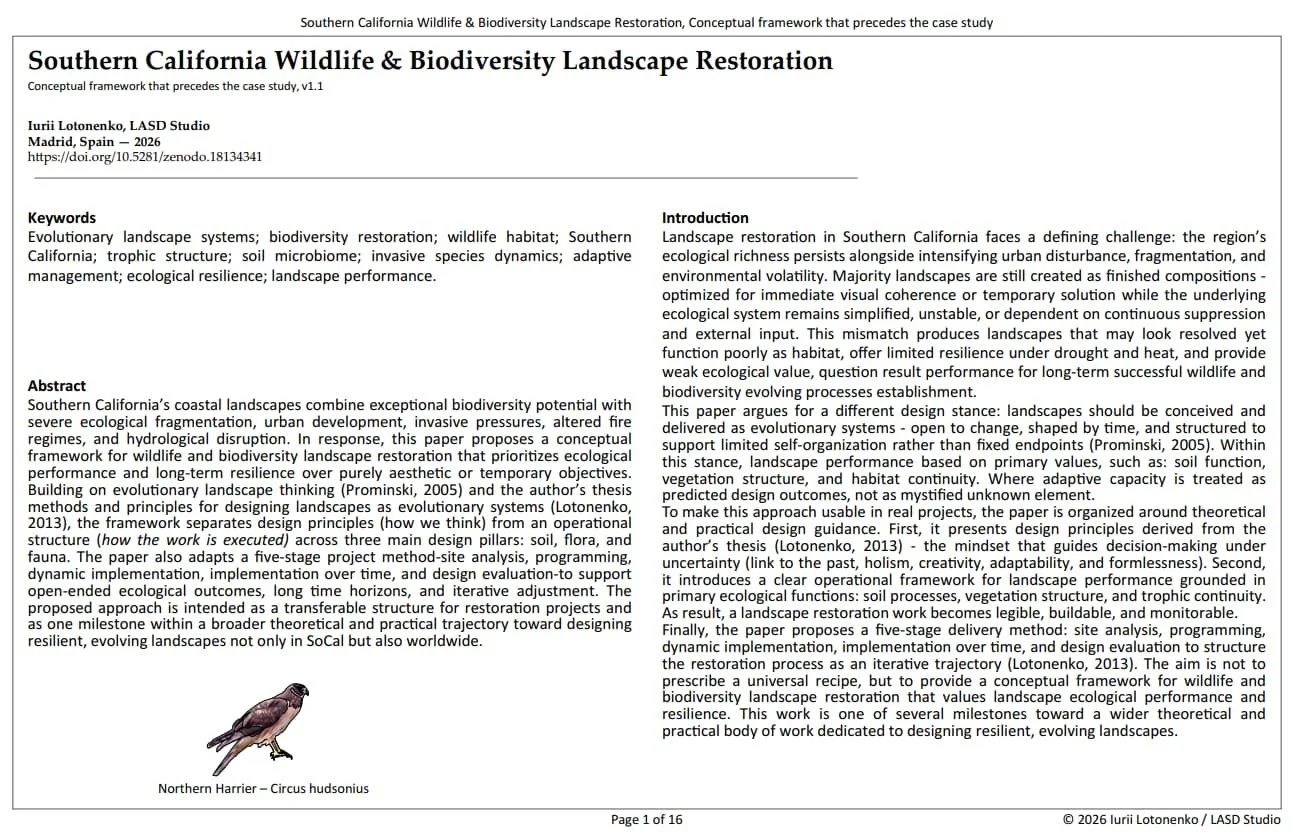
From aesthetic landscapes to ecological performance
Conventional landscape approaches often prioritize immediate visual resolution while leaving underlying ecological systems simplified or dependent on continuous input. This research proposes a different stance:
Landscape is treated as a living system, not a finished image;
Ecological performance leads; aesthetic quality emerges over time;
Wildlife presence is understood as an indicator of restored capacity, not decoration.
The framework separates design thinking from operational execution, allowing complex ecological systems to remain open, adaptable, and resilient.
The three interconnected pillars
The research is structured around three inseparable layers that define ecological capacity, those are:
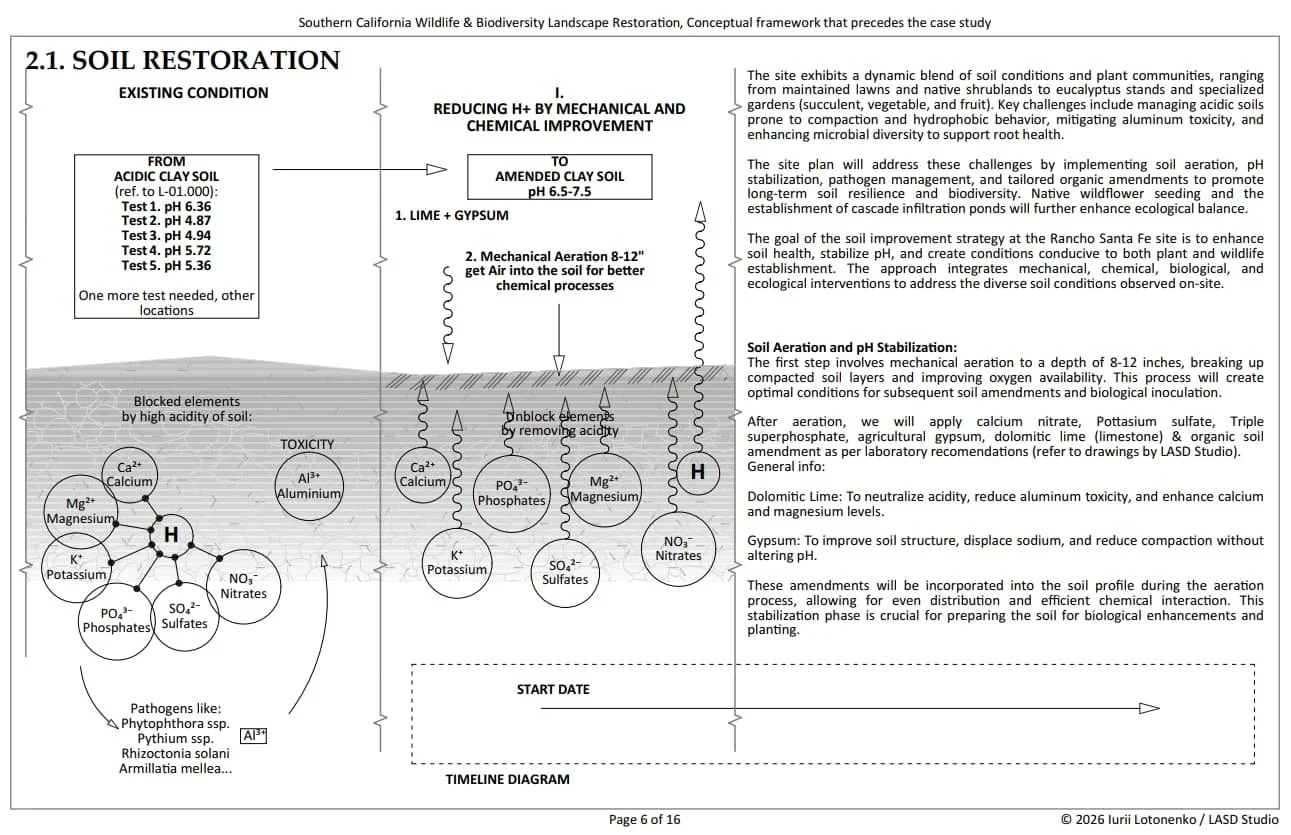
Soil
Soil is treated as the primary enabling system. Physical structure, pH balance, organic matter, microbial diversity, and mycorrhizal networks form the foundation for all higher ecological functions.
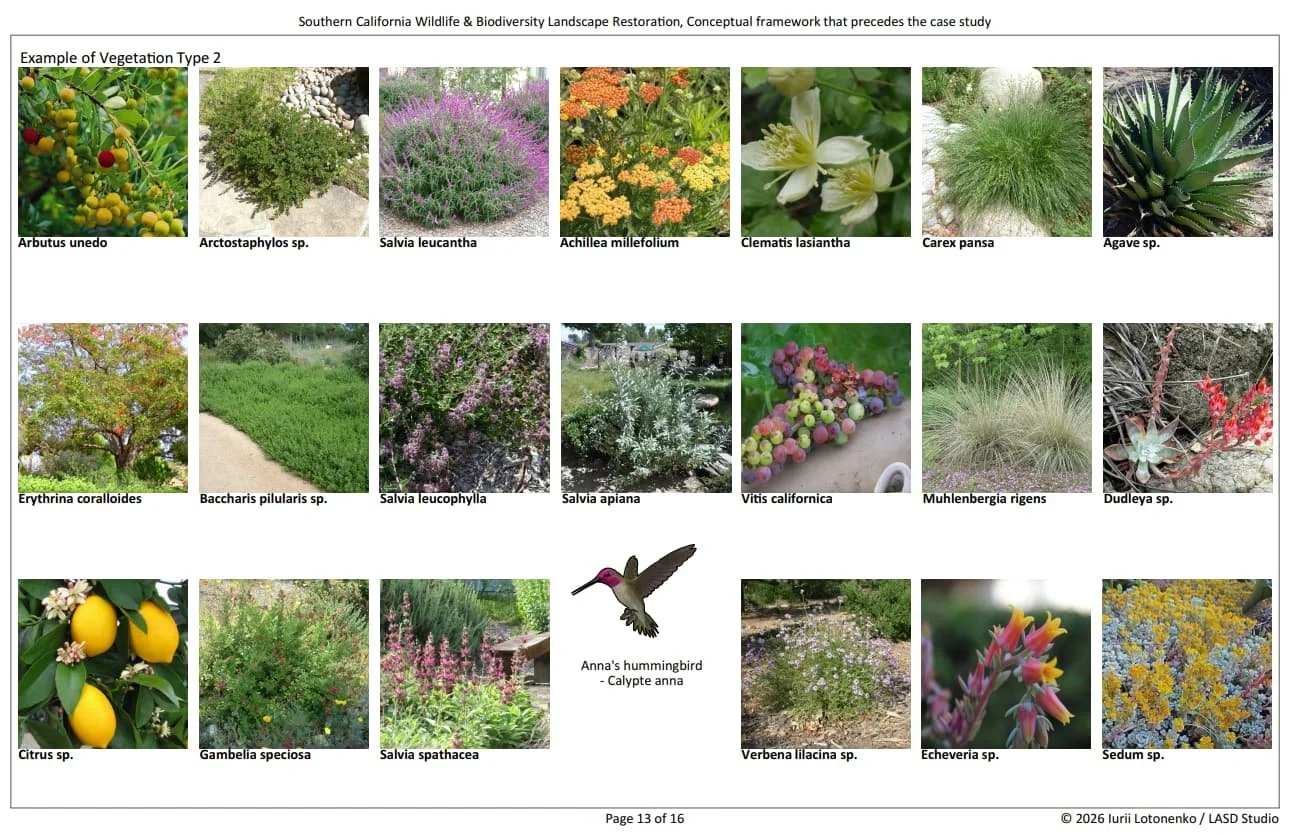
Flora
Vegetation is understood as habitat infrastructure rather than ornament. Plant selection and structure are evaluated based on ecological function, trophic support, microclimate creation, and long-term stability.
Fauna
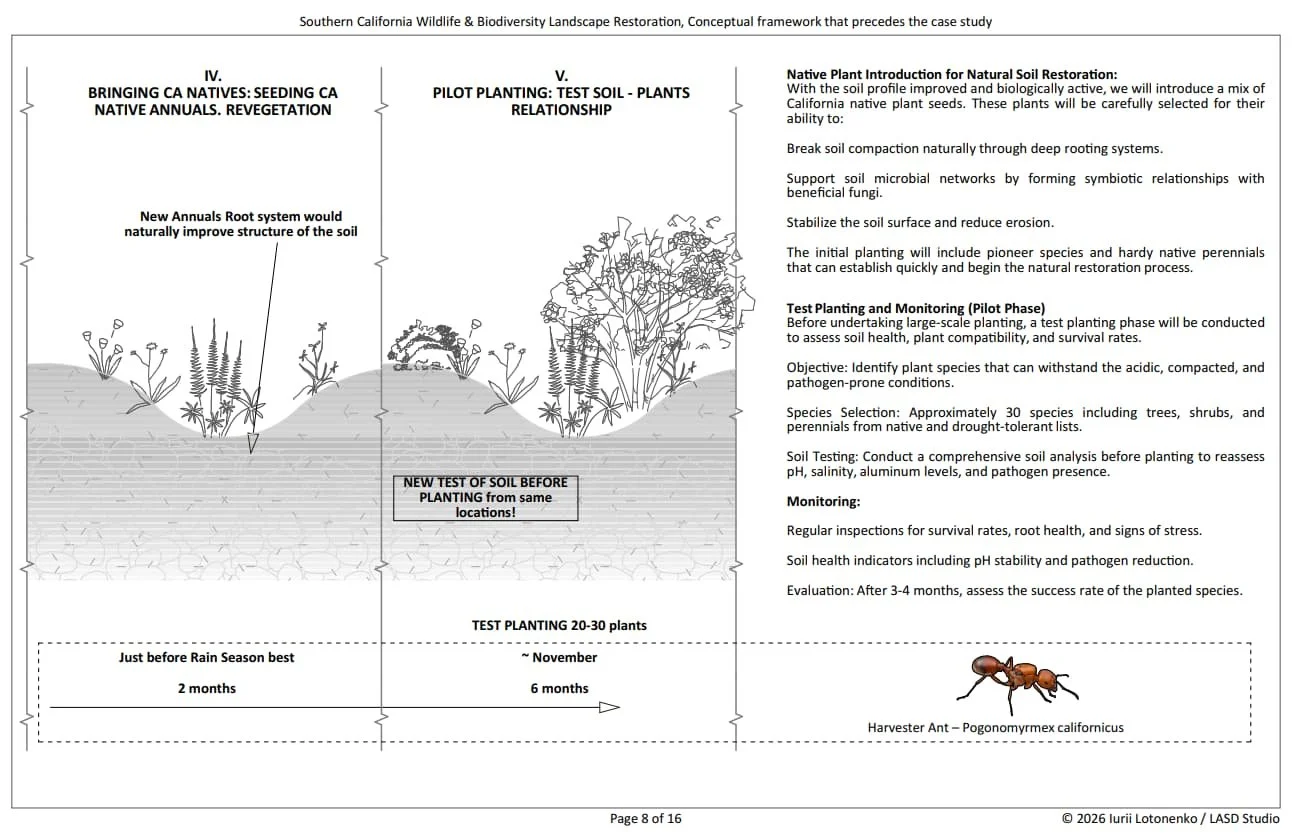
Wildlife emergence follows soil and vegetation recovery. Insects act as primary regulators, followed by birds, reptiles, and mammals as trophic networks mature and connectivity allows.
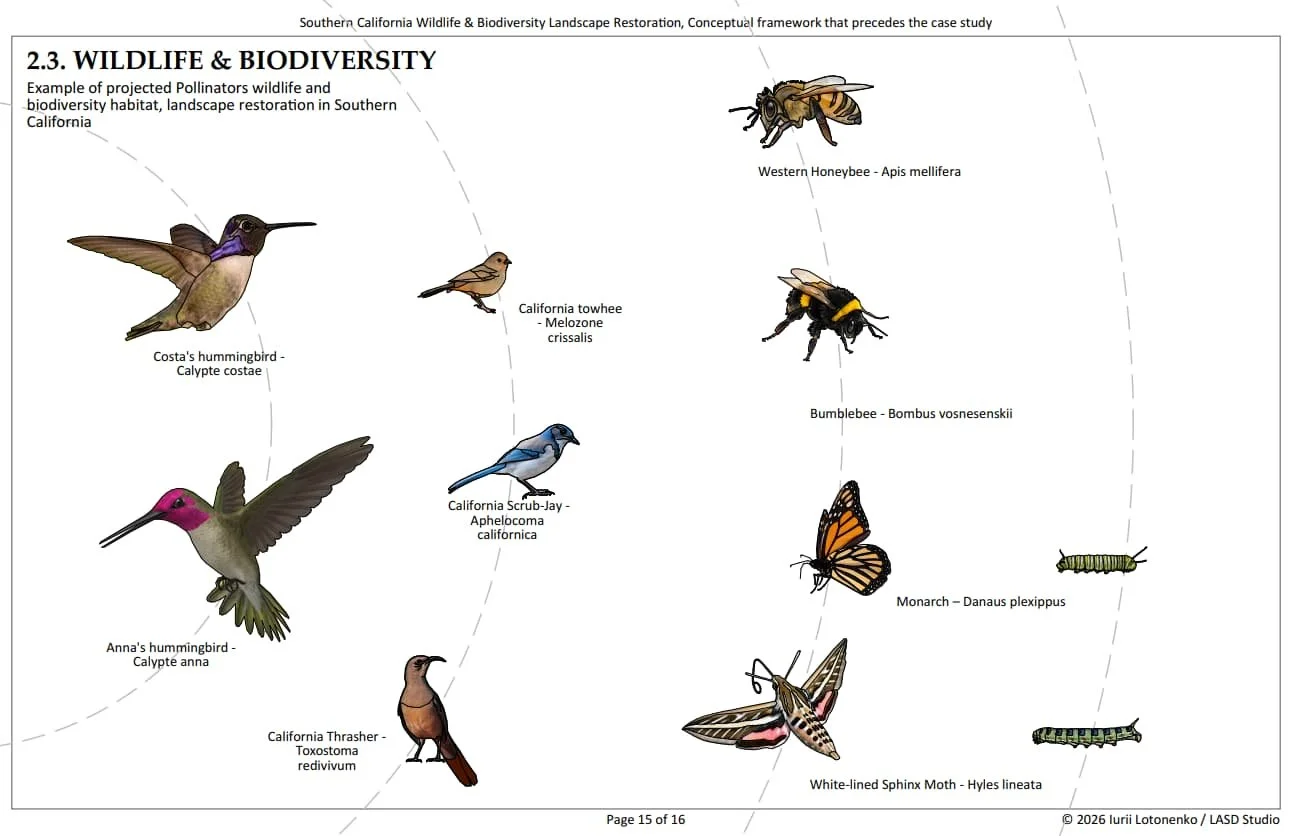
Time as another design dimension
A key contribution of this work is the explicit integration of time into landscape design and evaluation. Restoration is structured as a trajectory rather than a fixed endpoint, with performance observed and assessed across multiple time horizons, such as: Initial baseline; 6 months; 1 year; 3 years and beyond (monitoring).
This allows landscapes to be measured, adjusted, and improved, rather than merely maintained.
Applied, teachable, and transferable
The framework is intentionally designed to be “Applicable on real sites” (from private landscapes to larger restoration efforts), “Teachable” (with clear logic rather than abstract theory), “Transferable” (adaptable beyond Southern California to other regions worldwide).
It forms one milestone within LASD Studio’s broader research trajectory toward designing landscapes as evolving, life-supporting systems.
Full paper & citation
The complete research paper, including diagrams, case study structure, and references, is published and archived on Zenodo.
Southern California Wildlife & Biodiversity Landscape Restoration
Conceptual framework that precedes the case study
© 2026 Iurii Lotonenko / LASD Studio
Read the full paper on Zenodo - LINK: https://zenodo.org/records/18134341