
Ecological Planting Plans & Landscape Ecosystem Integrity Frameworks
Landscapes can no longer be designed as static decorative compositions. They must be understood as evolving ecological systems: layered, interconnected, and responsive to climate, soil, water, and biodiversity.
At LASD Studio, our Ecological Planting Plans are developed through ongoing research, including:
These frameworks translate ecological theory into practical, region-specific planting systems that can support biodiversity across trophic levels while maintaining architectural clarity and spatial beauty.
This page serves as the central hub for LASD Studio’s open ecological planting frameworks.
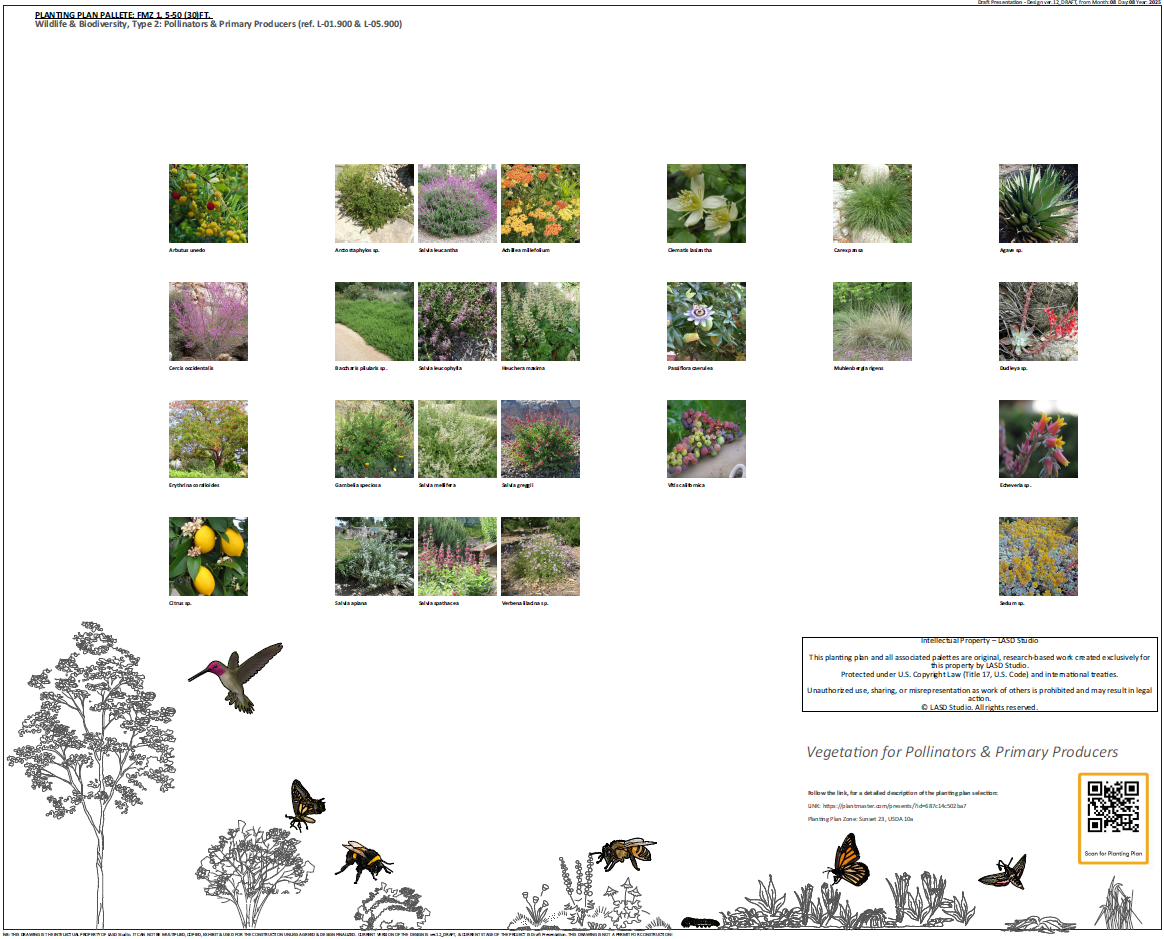
Why Ecological Planting Matters Now?
Across Southern California, and in many regions around the world - landscapes are under real pressure of urbanization and anthropogenic human activity: habitat has become fragmented, pollinators are declining, soils are losing vitality, wildfire risks are increasing, water is more limited. As result, climate patterns are shifting in ways we can no longer ignore in America, Europe, Australia and other continents.
At the same time, urban and residential gardens now cover enormous areas of land. When planted conventionally, these spaces often function as ecological gaps - visually pleasant, yet biologically quiet.
But the same land, designed with intention, can produce a different story: a private garden can become a small pollinator corridor, a backyard can support birds through seasonal seed and berry production, soil can be rebuilt rather than depleted, trees can store carbon and moderate microclimates, plant communities can adapt to drought rather than depend on constant irrigation.
Even modest properties, when structured as layered ecological systems, contribute to regional resilience. They reconnect fragmented habitat. They strengthen biodiversity. They restore processes that were once continuous across the landscape.
Planting Plan logic, in this context, is no longer simply aesthetic composition.
It becomes a quiet form of ecological responsibility - a distributed, living infrastructure that supports both beauty and life.
The LASD Studio Method
Our ecological planting frameworks are not random species lists.
They are structured according to:
Climate Intelligence
Based on Sunset Zones, microclimate conditions, marine influence, and fire interface constraints;
Trophic Layering
Integrating canopy, understory, shrub matrix, perennial succession, groundcover systems, and soil regeneration;
Hydrological Logic
Grouped by hydrazones and water-use modeling, aligned with MAWA/ETWU principles where applicable;
Biodiversity Support
Host plants for Lepidoptera, nectar continuity for pollinators, berry and seed production for birds and mammals;
Long-Term Evolution
Landscapes are designed to mature, self-organize, and strengthen ecological relationships over time.
This systems-based approach is part of LASD Studio’s broader research into Landscape Ecological Integrity (LEI), which evaluates how well a designed landscape supports ecological processes relative to its regional potential.
Research publications and theoretical essays are available in our Research section.
Open Ecological Framework for Private Gardens
We believe ecological knowledge should be shared.
For this reason, LASD Studio publishes selected regional planting frameworks as open resources for private residential use. When thoughtfully applied, even small gardens can strengthen biodiversity continuity and contribute to regional ecological resilience.
Private homeowners may use these frameworks freely in their own gardens, provided appropriate credit is given to:
LASD Studio - www.lasdstudio.com
Yura Lotonenko
These planting systems, however, are structured ecological frameworks - not simple species lists. When implemented at commercial, public, institutional, or development scale, they require professional oversight.
Large-scale application can influence wildlife patterns, fire compliance, water management, and invasive species dynamics. Without careful adaptation to site-specific conditions, ecological systems may create unintended imbalance.
For this reason, commercial or public use requires direct collaboration with LASD Studio to ensure responsible implementation aligned with Landscape Ecological Integrity & Evolutionary Landscape principles.
Regional Ecological Planting Plans
Each regional framework is adapted to local climate, soil, and ecological conditions.
Current frameworks include Mediterranean and coastal landscapes are shaped by climate, water availability, and long-term sustainability considerations specific to Southern California:
La Jolla Ecological Planting Plans & Landscape Ecosystem Integrity Framework (LINK);
Rancho Santa Fe Ecological Planting Plans & Landscape Ecosystem Integrity Framework (LINK).
Additional regions will be added as research and projects evolve.
From Framework to Built Landscape
The published planting frameworks represent ecological structure, a regional foundation for biodiversity and resilience based on LASD Studio research.
When translated into a site-specific design, that structure becomes integrated with architecture, circulation, views, and spatial sequencing. It responds to fire regulations and defensible space requirements. It aligns with irrigation engineering and long-term water strategy. Soil conditions are assessed and, where necessary, regenerated. Implementation is phased carefully, and construction is guided to protect ecological intent.
In this way, a framework evolves into a built landscape - one that is coherent, compliant, and evolving.
For property owners seeking a fully integrated ecological design tailored to their site, climate, and architectural context, LASD Studio offers professional consultation and landscape architectural design services in San Diego, Southern California, Spain, Europe and worldwide on demand.