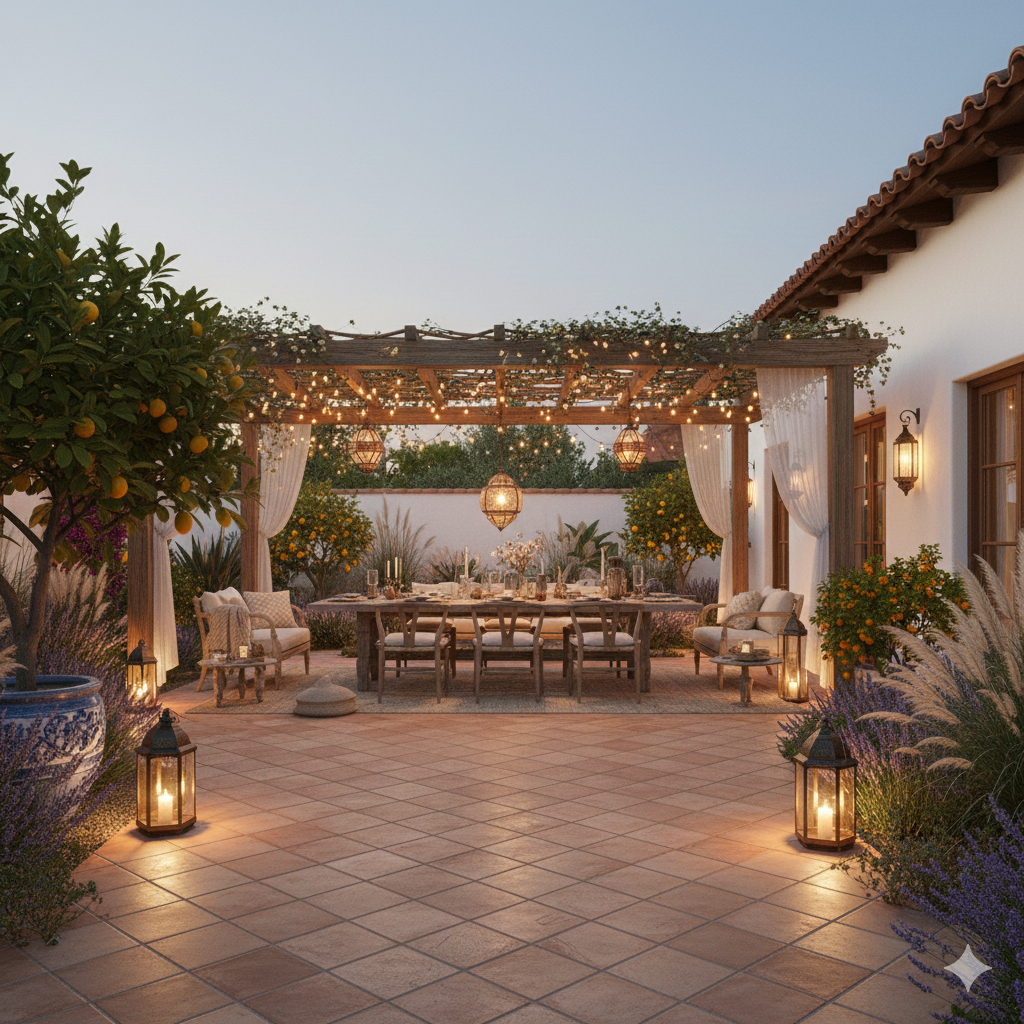
Design With Soul: Spanish Revival Gardens in Southern California
Spanish Revival is not one style. It is a blend. Moorish courtyard logic. Traditional Spanish Gothic mass and shadow. Mediterranean craft built for heat, drought, and daily use.
In Southern California, Spanish Colonial Revival style became a “residential language” that still holds, because it works with light, wind, and long dry seasons. Stucco walls and clay tile are not decoration. They are climate tools.
A Spanish Revival garden is planned around life first. Cooking. Arrival. Sitting in shade. Passing through an arch at dusk. It holds celebration, tension, emotions, and the connection to water, fire and freedom in one.
This article traces where the style came from. It defines what it means to design with soul. Then it translates Spanish Revival principles into garden structure that lasts.
For related work, see LASD Studio pages: Coronado Spanish Revival, Bohemian Minimalism in Mission Hills & Colonial Spanish Revival Estate.
Before we dive into Architecture style, lets listen Spanish guitar for a moment.
About song by:
Gipsy Kings - Gitano Soy
style: rumba flamenca style.
You may hear bright nylon-string guitar rasgueado, tight rhythmic strumming, hand percussion, and call-and-response vocals that ride the groove rather than sit on top of it.
This song carries pride, independence, and a sense of movement. Less nostalgia, more forward motion.
Where the style came from
Spanish Revival in California grew out of Spanish Colonial forms, then was reinterpreted through early 20th-century revival movements. Underneath the California version sits older material.
Moorish influence is visible in the logic of enclosure. Courtyards with inward focus. Walls that hold shade. Water used as sound and cooling. Tile as a skin that can take sun without cracking in spirit.
Traditional Spanish Gothic contributes weight and proportion. Thick edges. Deep reveals. Shadowed openings. A sense that the wall is not a membrane but a mass. That mass gives gardens their “room” quality because space is defined by surfaces, not by plant volume alone.
Mediterranean vernacular adds the everyday layer. Lime plaster. terracotta. gravel. olive and citrus. Tools and craft rather than ornament. A garden built from what is carried, repaired, and reused.
In Southern California, this blend found a climate that could support it. The long dry season makes shade structure essential. Coastal wind makes enclosure meaningful. Winter rain comes in pulses, so ground surfaces and drainage paths matter more than flower display.
Why Spanish Revival has soul?
People use the word “soul” when a place feels inhabited beyond the moment it was finished. In Spanish Revival, that feeling comes from traces of life that are allowed to remain visible.
Stone shows wear on corners. Tile holds hairline cracks without collapsing the whole composition. Wrought iron oxidizes. Stucco takes small repairs and keeps going. The garden reads like something maintained by hands, not erased by perfection.
There is also drama in the history. Spain’s landscape culture is not only celebration. It includes conflict, scarcity, and control of water and land. Courtyards are beautiful, but they are also defensive and climatic devices. Walls are poetic, but they also set boundaries.
That tension is part of why the style feels real. It is not an image of happiness. It is a built response to heat, politics, and family life continuing anyway.

What it means to design with soul?
Designing with soul is not about adding romantic or fancy objects. It is about making a framework where real life can accumulate.
A soulful garden accepts that people spill wine. Children drag chairs. An elder sits in the same spot to watch the light from younger generation. A dog makes a track along the wall. A pot gets chipped and stays, because it still works. We are accepting life as it is, still celebrating.
It also means designing for time. Not only plant growth, but surface aging. Where the shade will land at 6 pm in July. Where winter runoff will cut if you do not give it a path. Where moss might appear on the north side of a wall near a fountain (probably not in California but here in Spain :) ).
Soul is built through choices that allow use without breaking the composition.
Principles in Spanish Revival garden design
Start with the life, not the planting or fancy ideas.
Courtyard as center
The courtyard is the climatic heart. It reduces wind. It creates shade pockets. It allows planting that would struggle in full exposure. In Southern California it can reduce heat stress near living spaces.
Outdoor rooms
A dining terrace close to the kitchen. A shaded sitting court off the main room. A quiet corner for morning coffee where the ground is cool. Paths that connect these rooms without turning the garden into a corridor.
Shade structure
Pergolas, arcades, vine trellises, and canvas elements filter light. The goal is not darkness. It is patterned shade and air movement. In coastal zones, shade design should also account for wind lift and salt exposure.
Ground plane
Permeable surfaces matter. Decomposed granite, gravel bands, stone set with joints that drain, and courtyard pavers that shed water to planting basins. This is where Southern California performance lives.
Planting as structure
Olive, citrus, bay, and other drought-adapted canopy trees establish vertical order. Shrubs and herbs define edges and scent lines near paths. Groundcovers reduce evaporation and dust. Planting supports enclosure, not the other way around.
Lighting
Spanish Revival gardens come alive at night. Low light at steps. Warm light against plaster. Small pools of light under trees. It should support walking and sitting, not stage the whole yard.
Chose material honesty and meaning
Tile, lime plaster, terracotta, stone, and iron do not pretend. They age in place. Repairs show, and that is acceptable.
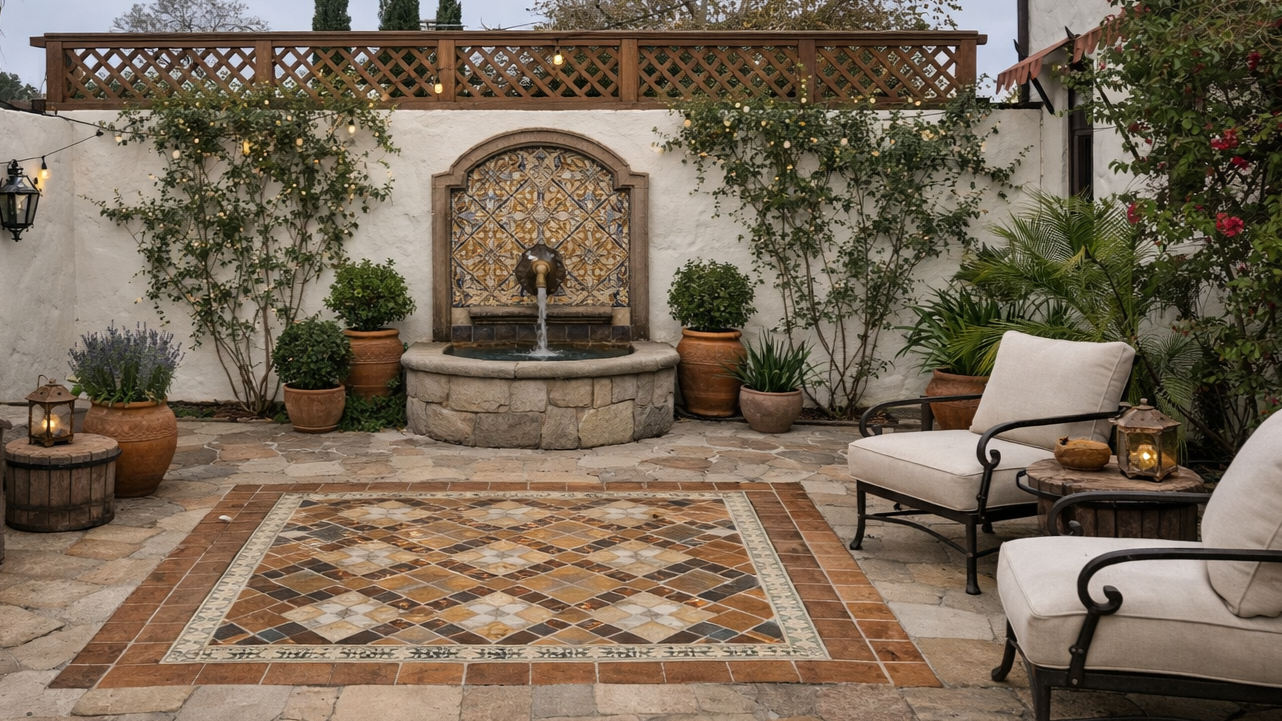
Life in the garden
A Spanish Revival garden is built for events and for ordinary days. It holds celebration, but it also holds waiting.
People cook outside. Music travels through arcades. Someone dances near the table because there is room and the ground is stable. An elder sits in shade and watches the movement, not because it is staged, but because the courtyard provides comfort.
Terracotta pots matter here, not as decor, but as carriers of continuity. A pot migrates from grandmother to children. It gets repotted. It moves to a new patio. It holds a citrus one decade and herbs the next. It is touched and reused because it is useful.
That is how a garden stays alive. Not by constant replacement, but by staying open to being lived in.

How LASD Studio works with this tradition?
At LASD Studio, we treat Spanish Revival as an inhabited system. Architecture sets enclosure. Climate sets rules. Craft sets material truth.
We design the plan around life first. Then circulation, microclimate, and planting structure. The result is a garden that supports daily use and improves as surfaces age.
Article prepared by Yura Lotonenko design lead of LASD Studio, while living in Spain.