Spanish Colonial Revival Design in Southern California Coastal Culture and Landscapes
Spanish Colonial Revival is not just a recognizable “look idea” (white stucco walls, tile roofs, arches, courtyards). In Southern California it became a consciously shaped regional identity: an architecture of optimism, tourism, and “good living” that, by the late 1920s, could read as the default visual language of entire neighborhoods and even whole towns.
A crucial nuance especially for publishing this as a studio journal piece, is that the style’s power comes from a blend of aesthetic coherence & cultural storytelling. A foundational architectural history of the movement notes that the revival had “little, if any” direct architectural rooting in the region’s deeper historic building stock, describing it instead as an architectural myth constructed by newcomers, yet one that proved unusually enduring and capable of high design quality. This tension (myth-making vs. craftsmanship and place-fit) is one reason the style remains so compelling to study, and to design today.
When the style is treated as “monumental heritage,” it often overlaps with formal preservation designations in the U.S. The National Register of Historic Places is the federal government’s official list of historic places “worthy of preservation,” created under the National Historic Preservation Act of 1966 and administered as part of a national preservation program. The National Historic Landmarks Program, by contrast, recognizes sites of national significance and includes thousands of designated landmarks across different property types. Understanding these frameworks matters for practice because they shape what is legally reviewable, what is fundable, and what is ethically expected when altering historic fabric.
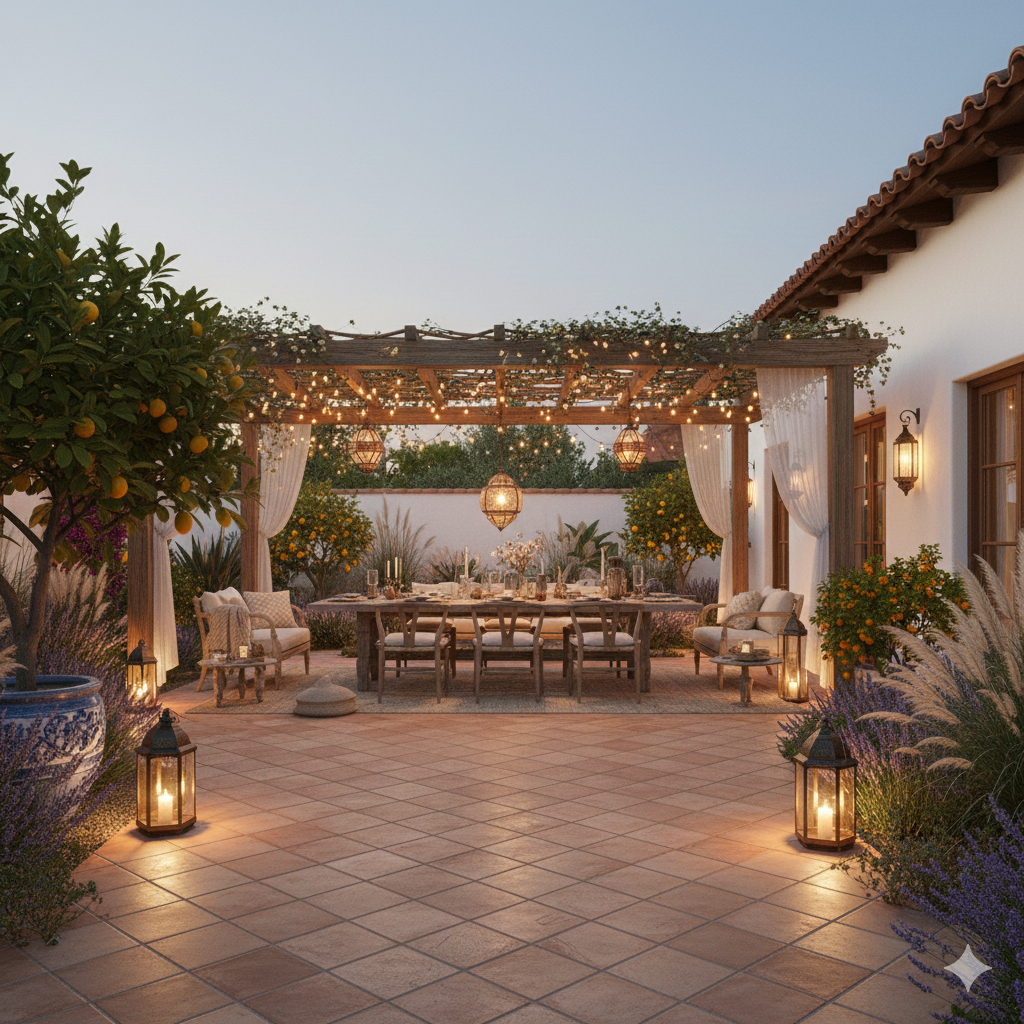
Jardín del Alma | Spanish Revival Garden Design | Landscape Architecture by LASD studio, San Diego
Jardín del Alma is a landscape designed in direct dialogue with architecture. The house carries the language of Spanish Colonial Revival with Mission and Mexican vernacular influence. Its massing, its hand-finished stucco, its presence in light. These elements are not treated as background.
Origins: fairs, nostalgia, and the making of a regional “heritage image”
Although Spanish Colonial Revival has precursors, the style’s popular ignition point in Southern California is closely linked to the 1915 Panama–California Exposition and its afterlife. A detailed study of the exposition’s design history emphasizes how the selection of Bertram Grosvenor Goodhue and his approach to a richly decorated Spanish colonial vocabulary created a long-lasting architectural legacy in Balboa Park, one that shaped how residents and visitors came to imagine “Spanish California.” The same account highlights the project’s early landscape ambitions, including the involvement of Olmsted Brothers in the exposition planning process.
The Santa Barbara story shows how Spanish Colonial Revival was also institutionalized through aesthetic regulation. The El Pueblo Viejo Landmark District design guidelines explicitly connect the 1915 exposition to a statewide revival of Spanish Colonial architecture, noting that participation was accelerated by rebuilding after the 1925 earthquake. In this telling, the movement was not only architectural, it was also civic and landscape-driven: local leaders such as Pearl Chase and Bernhard Hoffmann promoted a unifying style in a planned environment with landscaped spaces as a deliberate design strategy.
A third strand in the style’s origin story is heritage performance, the creation of curated “old world” streetscapes and destinations that packaged history into visitor experience. In Los Angeles, the City’s own history interpretive material records that Olvera Street opened as a Mexican marketplace on Easter Sunday in 1930, after the street had earlier been renamed in 1877 to honor Agustin Olvera. Scholarship summarized in the Avila Adobe entry at the Society of Architectural Historians’ reference site notes that some historians have read the surrounding plaza district as celebrating a “fantasy” Spanish heritage - while still acknowledging the district’s enduring civic significance.
Taken together, these streams - expositions, civic controls, and tourist heritage-making - help explain why Spanish Colonial Revival became so influential: it offered a coherent image that municipalities, developers, and cultural institutions could align around, and it scaled from landmark civic ensembles to mass-produced housing.
Architectural vocabulary: what the Spanish Colonial Revival style is “made of” and what it’s trying to do?
Spanish Colonial Revival is an umbrella term that can range from restrained to exuberant. A concise definition used by the Society of Architectural Historians describes it as a Western and Southwestern building movement evident in 1920s programs, generally featuring Spanish-style balconies, verandas and arcades, towers, pan-tiled roofs, and plazas/courtyards. A state-level architectural style reference similarly highlights clay tile roofs and round-arched openings, framing these as a revival of Spanish architectural themes from colonial-era settlements.
One of the most useful ways to understand the style, especially for designers, is to treat it as a system of climate-responsive massing + detail + landscape, rather than a kit of decorative motifs. The El Pueblo Viejo guidelines describe the tradition as a family of forms found in moderate climates (including Mediterranean coastal regions and Mexico), emphasizing broad stucco surfaces, deep reveals/porches/arcades, red-tiled roofs, enclosed patios and interior courtyards, and an overall sensitivity to site and topography. In other words: even when the style is romantic, it is also functional, about shade, privacy, outdoor rooms, and a calibrated relationship between building and garden.
Materials matter. The “white stucco + tile roof” cliché is not trivial; it is structurally and conservationally important. The U.S. government’s Preservation Brief on stucco explains how stucco is used as an exterior plaster system, how it is often misunderstood as sacrificial, and how water damage and inappropriate interventions can accelerate deterioration. The same brief links the early-20th-century revival styles, including Spanish Colonial and related Mediterranean variants, to the widespread adoption of stucco, explicitly noting that Spanish Colonial Revival helped popularize stucco because it visually echoed adobe. At the preservation level, the brief stresses that historic stucco is often character-defining and should generally be treated as significant historic material rather than stripped away.
A practical “what to look for” checklist (useful for field observation and for editorial photo planning) is therefore less about nostalgia and more about design intent, such as:
1) Massing and shade, sheltered entries, arcades/loggias, deep-set windows, and outdoor circulation that can function comfortably in bright sun;
2) Crafted surfaces, stucco as a continuous sculptural plane, paired with tile, wrought iron, carved wood, and masonry accents;
3) Courtyard logic, inward-facing organization that creates privacy and microclimate; gardens operate as rooms rather than leftover space.
Landscape architecture: courtyards, water, and planting as design drivers
In Spanish Colonial Revival, landscape architecture is not a “finish layer.” It is a core generator of the lived experience, often the part that makes the style feel timeless.
An architectural history of the movement argues that one of the revival’s major contributions was not only in standalone buildings, but in planned groups of buildings, city planning, and landscape gardening, with entire communities laid out in a coherent idiom. This is exactly where the style intersects with contemporary studio work: the space between buildings is as determinative of atmosphere as the façade.
The El Pueblo Viejo guidelines make this explicit. They describe landscaping as integral to a project’s design and state that the district’s Spanish Colonial Revival/Mediterranean tradition relies on landscape design as much as buildings, referencing combined sources from Spain, Moorish traditions (Iberia/North Africa), and Italy, and noting the role of symmetry, axes, and the interruption of vistas with fountains. The same section highlights that enclosed courtyards and patios historically supported a wide range of tropical and semitropical plants, while water features (fountains, narrow channels) were traditionally designed to use very small amounts of water.
This “garden-room” logic is visible in canonical estates. The Cultural Landscape Foundation’s profile of Casa del Herrero describes a garden composed of Moorish-style tiled fountains, citrus orchards, an axial vista, and a cactus garden, linked by paths and enclosed by arcades and whitewashed walls—exactly the kind of spatial sequencing that makes Spanish Colonial Revival landscapes feel simultaneously intimate and ceremonial. The site’s own institutional description also emphasizes that its landmark status is tied to both architecture and an eclectic mix of Moorish-inspired gardens.
On the planning side, Spanish Revival landscapes were also shaped by major American landscape planning lineages. The Palos Verdes Estates project history, as summarized by the Olmsted Network, notes that the Olmsted Brothers work there spanned decades (beginning in 1913), was extensive enough to require a West Coast office, and involved long-term on-site engagement, an indicator of how seriously the region treated landscape as a structuring, not decorative, discipline. A scholarly article on the planning history of Palos Verdes Estates similarly frames it as a planned community with Olmsted involvement across design and consultation.
At the scale of detail, even the National Park Service’s documentation of Olmsted work on private estates describes designs that mirrored Spanish Colonial gardens, furnished with pottery, outdoor furnishings, pools, and fountains, and planted with both California natives and species suited to Mediterranean climates.
Finally, landmark districts can explicitly value landscape architecture as a primary significance category. The National Register asset metadata for Balboa Park lists both LANDSCAPE ARCHITECTURE and ARCHITECTURE among its areas of significance, an unusually direct signal that the gardens, promenades, and spatial structure are part of what makes the place nationally important.
A field guide to places, projects, and heritage sites - references
Balboa Park (San Diego): the exposition ensemble as an origin-point.
If Spanish Colonial Revival has a public “cathedral” in Southern California, it is the Balboa Park complex shaped by the 1915 exposition legacy. The park’s National Register asset record (NRIS 77000331) highlights both architecture and landscape architecture as significance categories, underscoring that plazas, promenades, and garden structure belong to the site’s historical importance, not just the buildings. For architectural historians of the exposition, the key takeaway is endurance: the designed ensemble constructed around a century ago continues to testify to the movement’s lasting influence.
Photo prompts: arcades and shadow lines; tiled stairways and transitions; garden paths framing towers; the contrast of broad stucco planes against planting masses.
El Pueblo Viejo (Santa Barbara): regulated coherence + landscape-first urbanism.
The El Pueblo Viejo guidelines are unusually explicit about how Spanish Colonial Revival is practiced as a regulated civic identity: alterations in the district must be compatible with a Spanish Colonial Revival/Mediterranean tradition, with emphasis on early regional adobe and Monterey Revival precedents and the 1915–1930 Spanish Colonial Revival period. Just as importantly, the guidelines treat landscape as integral, an approach that aligns closely with a landscape-architecture-forward studio philosophy.
Santa Barbara County Courthouse: civic monument + garden composition.
The state historic resource listing notes the courthouse was designed in a Spanish Colonial/Moorish Revival idiom and is recognized as a major historic resource. The El Pueblo Viejo guidelines further document the courthouse complex and explicitly identify Ralph Stevens as landscape architect in their courthouse entry, an important reminder that Spanish Colonial Revival civic monuments were often conceived as building-and-garden compositions.
Los Angeles Plaza district and Olvera Street: heritage staging and cultural memory.
For a studio journal, this is where you can discuss the ethics of “heritage image.” The City of Los Angeles describes Olvera Street as one of the oldest streets in the city, renamed in 1877 and then opened as a Mexican marketplace on Easter Sunday 1930. Architectural reference material from the Society of Architectural Historians notes that some historians have criticized the surrounding plaza district as a manufactured fantasy of Spanish heritage, even while acknowledging its continuing importance as a civic birthplace site.
Adamson House (Malibu): Spanish Colonial Revival as coastal domestic theater.
The state designation entry describes Adamson House as a Spanish Colonial Revival home designed in 1929 by Stiles O. Clements, noting it contains exceptional surviving decorative tile associated with Malibu Potteries. The state parks interpretive page similarly frames the site as a Spanish Colonial Revival home and situates it within broader Malibu history.
Casa del Herrero (Montecito): the garden as a sequence of rooms.
As noted above, Casa del Herrero is a particularly strong case study for a landscape architect because its significance is inseparable from garden structure: Moorish tiled fountains, orchard geometry, and enclosed garden rooms are central features in cultural landscape documentation.
Palos Verdes Estates: planned-community landscape DNA.
Spanish Colonial Revival is often discussed as house style, but planned communities show the deeper mechanism: deed restrictions, street hierarchies, and view corridors become style enforcers. The Olmsted Network emphasizes the sustained, decades-long scope of the Olmsted Brothers’ work at Palos Verdes Estates, highlighting the seriousness of the project as designed environment.
San Clemente: the “Spanish Village by the Sea” as a developer’s manifesto.
For a coastal-life narrative, San Clemente is essential because its founding story explicitly ties Spanish Colonial imagery to seaside identity. The Advisory Council on Historic Preservation describes how Ole Hanson envisioned a red-roofed Spanish village by the sea in 1925, purchased acreage, and shaped civic amenities around a Spanish theme. The San Clemente Historical Society offers a parallel summary of this 1925 “Spanish Village by the Sea” concept, situating it between Los Angeles and San Diego geographically and culturally.
Rancho Santa Fe: inward-facing planning and courtyard typology.
The Rancho Santa Fe Historical Society describes La Flecha House as the first residence in Rancho Santa Fe designed by Lilian J. Rice (1923) and as an early example of the community’s Spanish Colonial Revival architectural direction. A San Diego preservation newsletter on Rice’s Spain travels explicitly links observed design principles to inward-facing homes and courtyard traditions used in Rancho Santa Fe’s civic work.
Ojai Valley Inn: resort Spanish Colonial Revival and landscape luxury.
Historic Hotels of America notes that the resort’s early clubhouse was designed in Spanish Colonial Revival style by Wallace Neff as part of the property’s evolution. Even when later expanded, the core idea remains: outdoor living, courtyards, and landscape “atmosphere” are inseparable from the architecture’s identity.
Coronado: formal designation culture and Spanish-influenced domestic work.
If the goal is to connect Spanish Colonial Revival to “monumental heritage” and local protections, Coronado is a useful example because the City maintains a designated historic resources register that includes multiple entries identified as Spanish Colonial Revival. For broader architectural context, the Coronado Historical Association documents Spanish-Revival commercial work such as La Avenida (built 1938) and identifies a notable local builder involved. The association also highlights Spanish Colonial Revival residential designations in its discussion of Cliff May and related Coronado houses.
A parallel landmark narrative is the resort-scale historic environment of Hotel del Coronado, which Historic Hotels of America notes was listed in the National Register (1971) and designated a National Historic Landmark (1977).
Designing today: preservation discipline, water realism, and the studio role
A contemporary studio working with Spanish Colonial Revival has two simultaneous responsibilities:
First, treat character-defining material honestly. With stucco, the federal preservation guidance is clear that historic stucco is widespread, often misunderstood, and vulnerable to water damage and inappropriate removal; it should generally be treated as a significant historic material and repaired in ways that respect original texture and composition. This is not a “historian’s preference” - it is practical building stewardship.
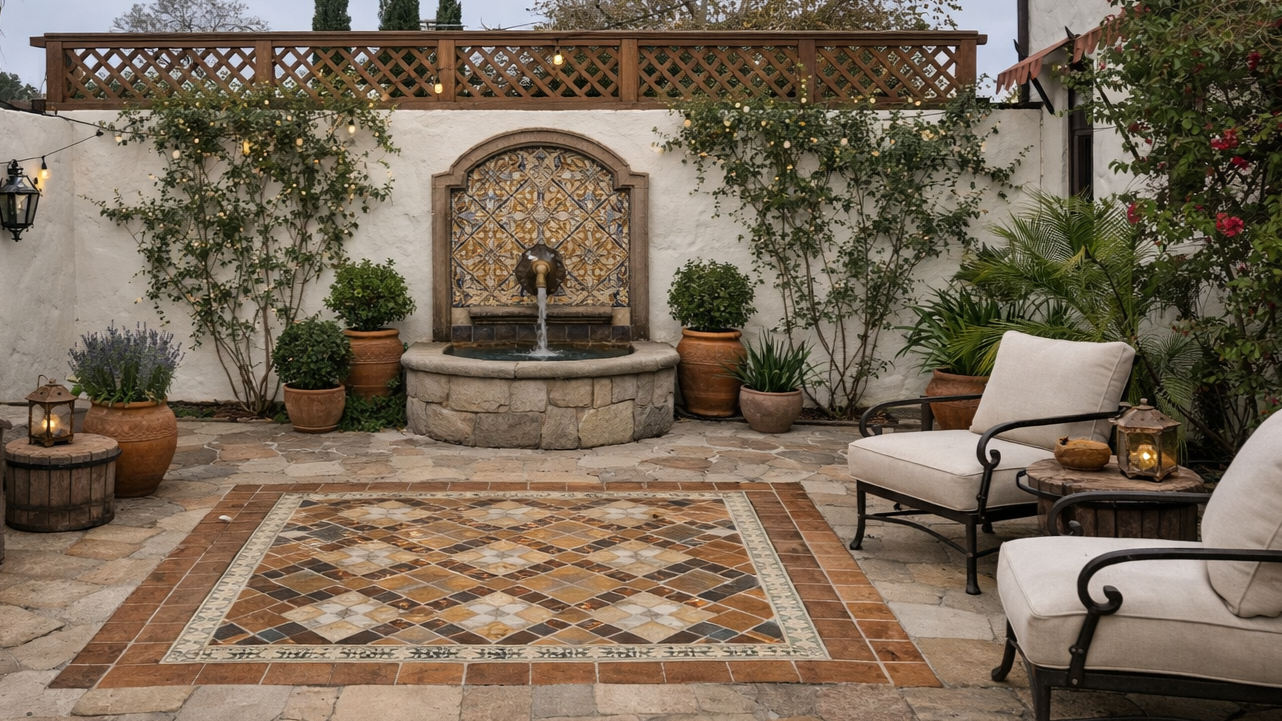
Second, treat landscape as architecture. The El Pueblo Viejo guidelines do not treat landscape as optional beautification; they define it as integral, describing how Spanish Colonial Revival landscapes draw from Spain, Moorish traditions, and Italian precedent, with water features historically designed to be sparing and courtyards functioning as planted microclimates. This integrates directly with modern coastal realities: glare, wind, privacy, outdoor living, and water constraints are solvable through spatial planning rather than surface styling.
For a studio journal voice (including Lacy Studio’s positioning), a compelling way to frame the practice is:
Spanish Colonial Revival succeeds when architecture and landscape share a single philosophy: clarity of massing, disciplined craft, and outdoor rooms that feel inevitable to the site,
The most “magnificent” examples are rarely the loudest; they are the ones where courtyards, arcades, planting, and water are choreographed as a sequence: comfort first, romance second, and life permanence always.
If you include a call-to-action button (“Request a design proposal”) in your business profiles, the strongest conversion language typically aligns with this article’s core thesis: heritage-sensitive design + landscape-first spatial craft + climate-fit performance, not generic “Spanish style” decoration.

Selected bibliography and reference sources
The Architecture and the Gardens of the San Diego Exposition, a primary-period pictorial survey (published 1916) documenting the exposition’s aesthetic program, including gardens.
California Vieja: Culture and Memory in a Modern American Place, a scholarly study whose table of contents signals sustained attention to the exposition, Rancho Santa Fe, and Olvera Street as public-memory sites.
California's Mission Revival, a book-length treatment of Mission Revival’s development and influence (useful for distinguishing Mission Revival from later Spanish Colonial Revival phases).
Red Tile Style: America's Spanish Revival Architecture, a national-scale survey emphasizing the breadth of Spanish Revival/Spanish Colonial Revival permutations.
National Park Service, Preservation Brief 22 (stucco), technical preservation guidance on the nature of historic stucco, common failure modes, and appropriate repair principles.
City of Santa Barbara, El Pueblo Viejo Design Guidelines, an unusually detailed municipal document explicitly integrating architectural controls with landscape design expectations and historic context (including post-1915 revival and post-1925 rebuilding).
City of Los Angeles, Olvera Street historical overview, municipal interpretive summary of the street’s renaming and the 1930 marketplace opening.
The Cultural Landscape Foundation profiles (Casa del Herrero; Balboa Park), cultural landscape documentation useful for landscape-architecture reading of Spanish Colonial Revival spatial sequencing and garden structure.
Advisory Council on Historic Preservation, San Clemente case page, an official preservation-sector summary of the “Spanish Village by the Sea” vision and its civic planning implications.