
~ Rancho Santa Fe Ecological Planting Plan ~
Sunset Zone 23–20 Transitional (10a–10b)
A Landscape Ecological Integrity Framework for Inland-Coastal Southern California
Rancho Santa Fe occupies a unique ecological position within Southern California. Situated between coastal influence and inland heat corridors, its rolling estates, canyons, and riparian edges form part of a larger ecological mosaic that extends beyond property lines.
Unlike dense urban landscapes, Rancho Santa Fe retains parcel scale, where with scale comes responsibility.
The Rancho Santa Fe Ecological Planting Plan developed by LASD Studio is a research-based framework designed to support biodiversity continuity, climate resilience, and long-term landscape stewardship. Grounded in our work on Southern California Wildlife & Biodiversity Landscape Restoration and the broader theory of Landscape Ecological Integrity, this framework translates ecological systems thinking into regionally appropriate planting structure.
Ecological & Climatic Framework
Rancho Santa Fe sits within a transitional climatic zone. Marine influence moderates temperatures at times, yet inland heat pockets, periodic drought, and increasing wildfire pressure shape long-term ecological dynamics.
Large parcels allow for layered ecological systems, but they also intersect with chaparral and coastal sage scrub ecologies, canyon wildlife movement, riparian corridors, defensible space requirements.
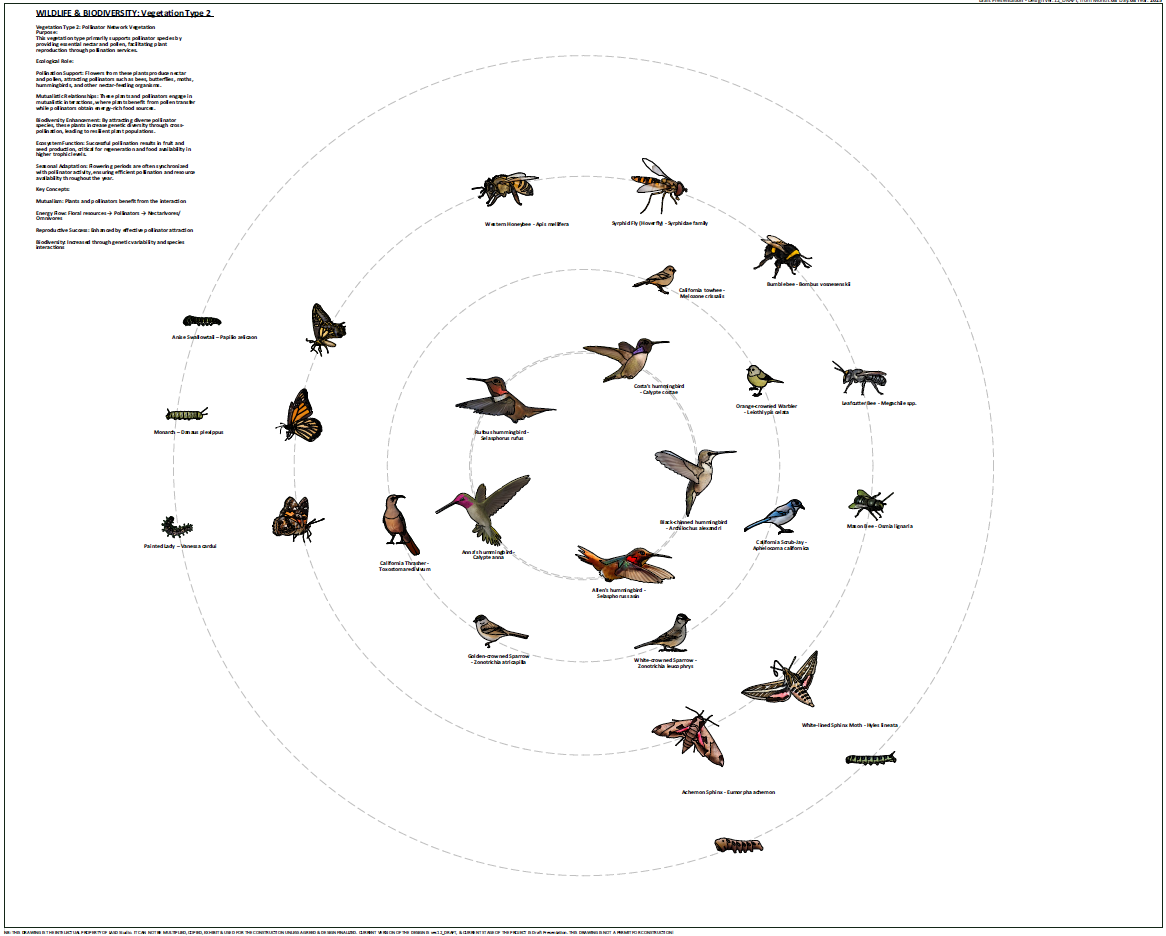
The proposed framework that partially published in Southern California Wildlife and Biodiversity Landscape Restoration is structured to support: a) native canopy regeneration, particularly oak systems where appropriate, b) shrub matrices that stabilize soil and reduce long-term irrigation demand, c) nectar and host continuity for pollinators and beneficial insects, d) berry and seed production supporting birds and small mammals, e) habitat edges that allow for wildlife passage.
When thoughtfully designed, estate-scale landscapes can function as stepping-stone habitats within larger ecological corridors. In some cases, they contribute to safe migration routes for higher trophic species - including raptors, coyotes, and other apex or mesopredator wildlife moving between canyon systems.
Landscape Ecological Integrity, in this context, is measured not only by plant survival, but by trophic function, hydrological resilience, and long-term ecological coherence.
Structured Plant Palette
The Rancho Santa Fe framework is organized as a layered ecological system adapted to estate-scale properties and transitional inland–coastal conditions.
Canopy Layer
Native oaks, sycamores in drainage zones, and regionally appropriate long-lived trees provide structural identity, carbon storage, and nesting habitat. Preserving and reinforcing mature canopy systems is central to long-term ecological stability.
Transitional Trees & Orchard Layer
Rancho Santa Fe carries a legacy of orchards and cultivated groves. Ecological orchard integration — citrus, olive, or other regionally compatible species — can coexist with native habitat layers when structured thoughtfully.
Shrub Matrix
Chaparral-informed and fire-aware shrub systems create the ecological backbone of the landscape. Species are selected for drought resilience, wildlife support, and defensible space adaptability.
Perennials & Native Grasses
Native grasses and perennial communities provide nectar continuity, seed for birds, and soil stabilization across open meadow-like zones common in larger estates.
Habitat Edges & Riparian Adjacent Zones
Where properties interface with canyon or drainage systems, planting must be carefully adapted to maintain ecological continuity without encouraging invasive spread or increasing fire risk.
Together, these layers create a resilient, evolving system designed to mature over time while maintaining architectural clarity and estate refinement.
From Framework to Estate Resilient Landscape
The published framework represents ecological structure at a regional level.
When translated into a site-specific estate landscape, it becomes integrated with architecture, long approach drives, arrival courts, equestrian infrastructure, outdoor living spaces, and expansive viewsheds. Grading, irrigation zoning, soil regeneration, and fire compliance strategies are woven into the design process.
Phased implementation is particularly important in larger properties. Ecological systems establish gradually, allowing for monitoring, adaptation, and long-term performance.
For clients seeking fully integrated ecological design in Rancho Santa Fe, LASD Studio provides professional landscape architectural services grounded in research, spatial clarity, and environmental stewardship.
This is where framework becomes built legacy.
Stewardship & Open Use
This Rancho Santa Fe Ecological Planting Plan is published as an open framework for private residential use. Homeowners may apply its principles within their own properties, provided appropriate credit is given to LASD Studio and Yura Lotonenko.
Commercial, public, institutional, or development-scale application requires direct collaboration with LASD Studio.
Estate-scale ecological systems influence wildlife movement, fire compliance, water management, and long-term habitat dynamics. Improper adaptation can unintentionally create ecological imbalance or regulatory conflict.
Our intention is stewardship, ensuring that ecological planting strengthens resilience, supports biodiversity, and respects regional environmental realities.
In Rancho Santa Fe, landscape stewardship extends beyond aesthetics.
It shapes the ecological future of the land itself, check Our Mission.