
~ Landscape Ecosystem Integrity as Preventive Infrastructure ~
Foundations for Designing Landscapes as Evolving Systems
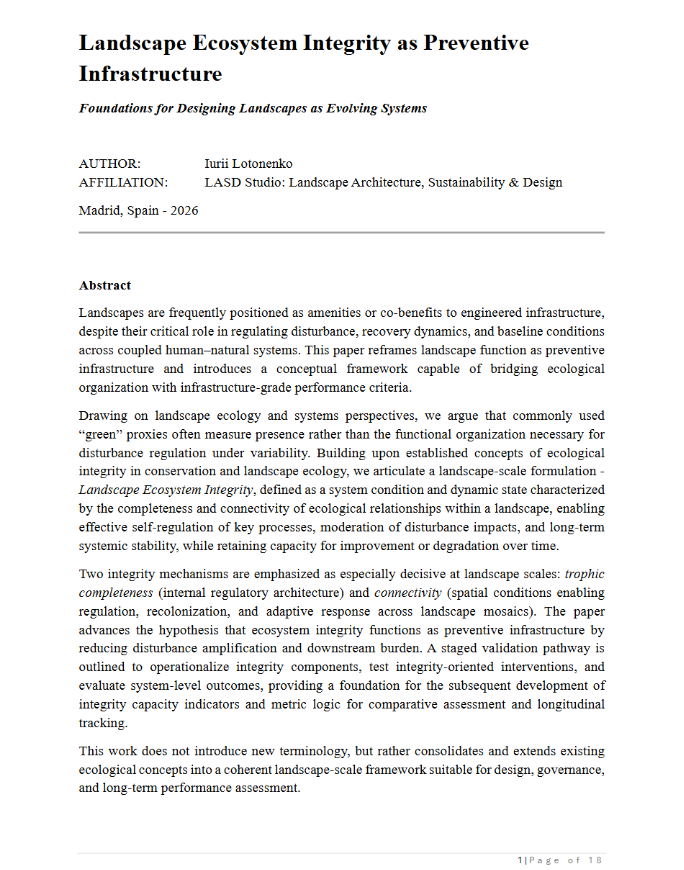
Landscapes are often treated as amenities or visual enhancements, while their critical role in regulating disturbance, recovery, and long-term system stability remains undervalued. This research reframes landscape systems as preventive infrastructure - capable of reducing risk, moderating disturbance impacts, and supporting long-term ecological and human resilience when properly structured.
What is Landscape Ecosystem Integrity (LEI)?
Landscape Ecosystem Integrity (LEI) is defined as a system condition and dynamic state characterized by the completeness and connectivity of ecological relationships within a landscape. High integrity enables self-regulation, disturbance moderation, and long-term stability while retaining capacity for improvement or degradation over time.
Why “preventive infrastructure” ?
Rather than responding to failure after disturbance occurs, landscapes with high ecosystem integrity reduce disturbance amplification in advance. In this sense, landscape ecosystem integrity functions as preventive infrastructure - lowering downstream ecological, social, and economic burden before crises emerge.
An illustrative example from ecological systems
Research on black garden ants (Lasius niger) provides a clear example of how spatial structure itself can function as a form of regulation. When ant colonies are exposed to a pathogen, they do not rely solely on behavioral isolation or individual immune responses. Instead, they actively modify the physical architecture of their nests.
Using X-ray micro-computed tomography, researchers observed that infected colonies reduced the number of tunnel connections and increased the spacing and isolation of nest entrances. These architectural changes slowed the movement of fungal spores through the nest and reduced exposure of larvae and food stores. In effect, the ants reshaped their environment so that self-isolation could function more effectively.
This phenomenon has been described as architectural immunity: a form of system-level regulation in which spatial organization reduces disturbance amplification before catastrophic spread occurs. Rather than reacting after collapse, the colony adjusts its structural configuration to moderate risk in advance — a principle that closely parallels the concept of Landscape Ecosystem Integrity as preventive infrastructure.
Reference: Leckie, L., Sinha Andon, M., Bruce, K., & Stroeymeyt, N. (2025). Architectural immunity: ants alter their nest networks to prevent epidemics. Research conducted by University of Bristol researchers and collaborators.

The two cores of landscape ecosystem integrity mechanism
Landscape Ecosystem Integrity is expressed through two tightly coupled mechanisms that operate together across scales: trophic completeness and connectivity.
Trophic completeness describes the internal regulatory architecture of ecosystems. In intact systems, insects function as primary regulators, initiating and stabilizing ecological processes that support higher trophic levels. Vegetation is structured in layered forms rather than simplified plant palettes, allowing energy, nutrients, and habitat functions to circulate through the system. As ecological capacity increases, birds, reptiles, and mammals emerge not as decorative additions, but as stabilizing agents within maturing trophic networks. Regulation occurs through continuous bottom-up and top-down feedbacks rather than through external control or constant human intervention.
Connectivity describes the spatial conditions that allow these regulatory processes to operate across the landscape. Functional landscapes enable movement between habitat patches, support recolonization after disturbance, and allow adaptive responses to unfold over time. When connectivity is disrupted through fragmentation, ecological regulation weakens, recovery slows, and disturbance impacts intensify. Integrity therefore depends not only on what exists within a site, but on how that site relates to its broader ecological context.
Time as a design dimension
Landscape Ecosystem Integrity cannot be evaluated at a single moment. Performance emerges over time and must be understood as a trajectory rather than a fixed endpoint. Restoration is therefore approached as a dynamic process, with ecological conditions observed and assessed across multiple temporal horizons.
Initial baselines establish starting conditions, while subsequent evaluations at six months, one year, three years, and beyond reveal whether ecological processes are stabilizing, improving, or degrading. This time-based perspective allows landscapes to be adjusted, corrected, and strengthened rather than merely maintained in a static state.
From research to application
The framework is intentionally structured to operate beyond theory. It is designed to be applicable on real sites, teachable through clear and transferable logic, and adaptable across regions beyond Southern California. Rather than prescribing a universal recipe, it provides a coherent structure for decision-making that can be adjusted to local conditions, constraints, and regulatory environments.
In practice, the framework supports landscape architectural design, ecological restoration planning, governance and review processes, and long-term monitoring and evaluation. Its purpose is not to replace design intuition, but to give ecological performance a legible and testable structure within real projects.

Relation to LASD Studio’s broader work
This research represents one milestone within LASD Studio’s broader trajectory toward designing landscapes as evolving, life-supporting systems. It builds upon earlier theoretical work and extends those ideas into an operational framework capable of informing design, implementation, and long-term observation.
The Landscape Ecosystem Integrity framework is closely connected to Designing Landscapes as Evolutionary Systems and to applied research in Southern California Wildlife and Biodiversity Landscape Restoration, forming a continuous line between theory, method, and practice.
Full paper & citation
The complete research paper, including diagrams, references, and methodological structure, is published and archived on Zenodo.
Landscape Ecosystem Integrity as Preventive Infrastructure: Foundations for Designing Landscapes as Evolving Systems
© 2026 Iurii Lotonenko / LASD Studio
Read the full paper on Zenodo - LINK: https://zenodo.org/records/18422353