
Authentic Japanese garden design beyond Japan
In Kyoto, one of the materials most closely associated with the image of a Japanese dry garden can no longer be quarried. Shirakawa-suna, the pale granite gravel seen across temple landscapes, became scarce enough that extraction was prohibited. A peer-reviewed survey of Kyoto temples found river sand, Shirakawa-ishi gravel and other substitutes already being used across hundreds of garden areas. The researchers recommended choosing replacement material by physical character: grain, depth, texture and the way it performs in the garden.
That detail changes the question of authenticity. Even in Kyoto, continuity does not always mean preserving the original material. The garden survives because knowledge is carried forward: how the ground is composed, how stone sits in relation to architecture, how the surface is raked and maintained, how light moves across it, and how the garden is cared for after the designer leaves.
This is where our interest in Japanese garden art begins. LASD Studio works in Southern California and Spain, places with very different climates, geology, plant communities, construction cultures and regulations. A Japanese garden in Asturias should absorb Atlantic rain and soft green light. A garden in Mallorca should understand limestone, terraces and water scarcity. A garden above a San Diego canyon may need to work with dry summers, hard light, wildfire requirements and distant borrowed scenery.
The design can remain faithful while the garden belongs completely to its own ground. That possibility is the foundation of our Japanese garden work.
Considering a landscape project?
What the tradition asks of a garden
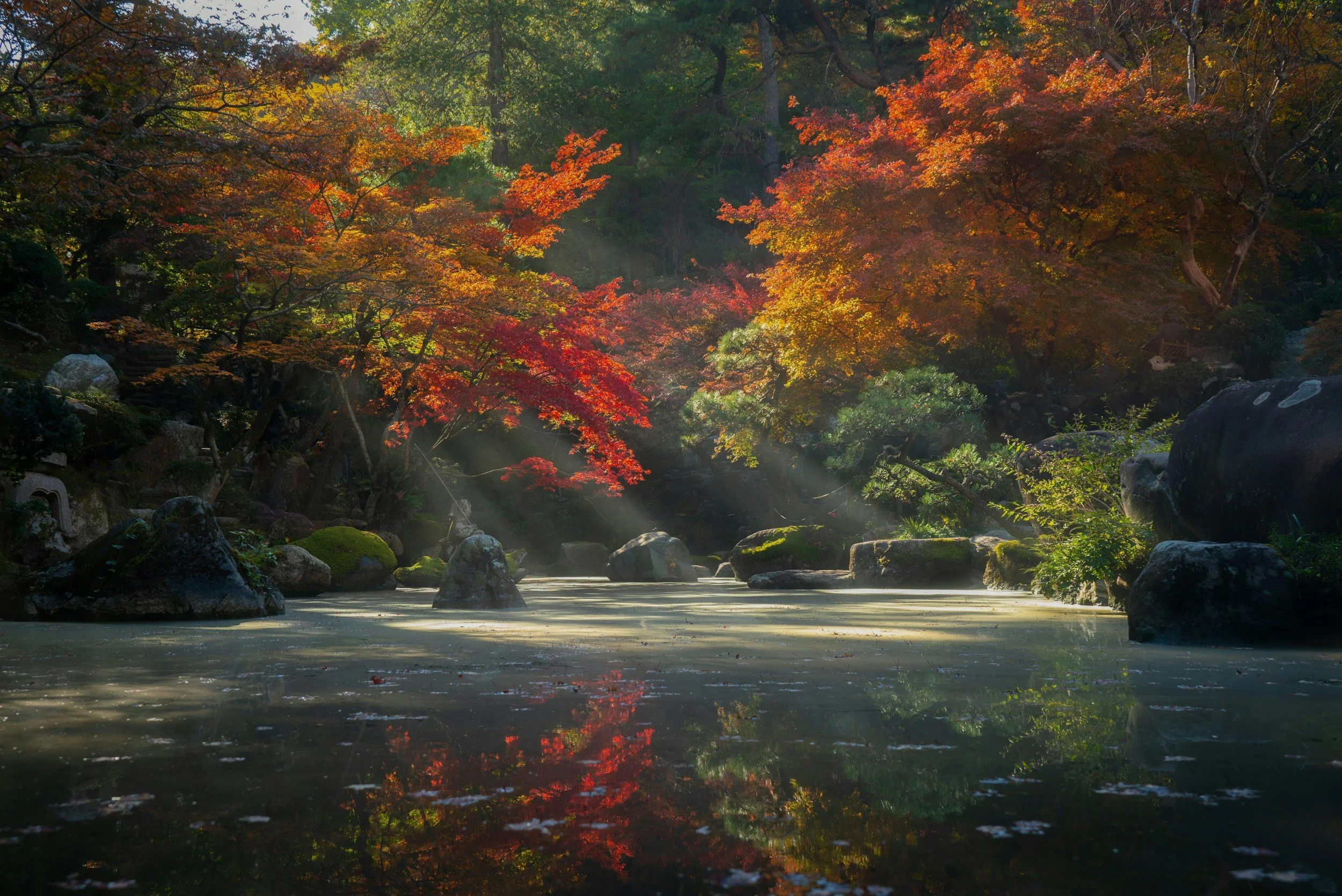
The oldest surviving Japanese garden-making treatise, the Sakuteiki, describes garden making through the act of setting stones. Its language asks the gardener to follow the “request” of the stone: to study the material, its grain, weight, natural orientation and relationship to the site before deciding where it belongs. The instruction is practical and philosophical at the same time. The material is encountered before it is controlled.
This way of working leads to a garden that is read through relationships. The gap between two stones matters. The pace of a path matters. A wall can hold back a view until the moment it should appear. A low branch can suppress the horizon for several steps, then release it. A garden may borrow a mountain or a distant tree line and make that outside landscape part of the composition without owning a metre of it.
The interval becomes part of the design
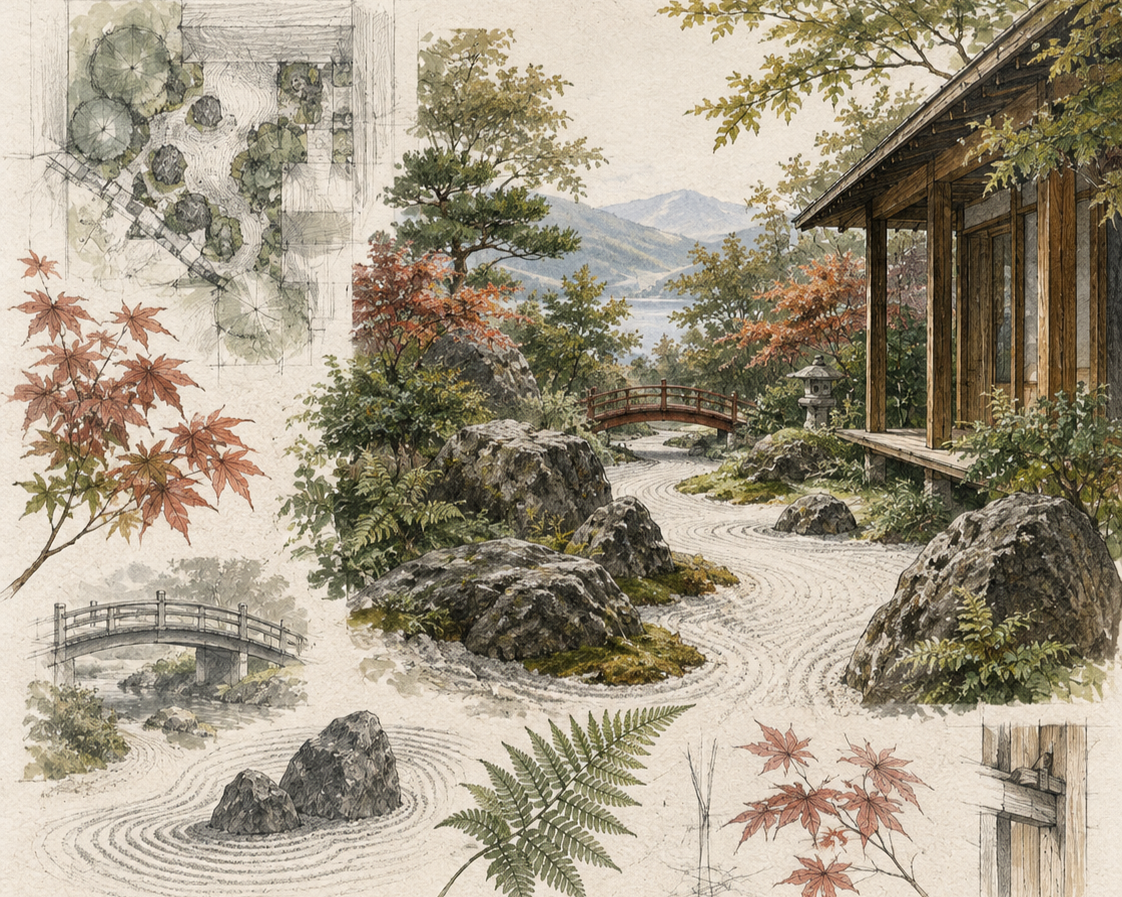
Ma is often translated as emptiness or interval. The translation is useful only when the space between things is treated as actively as the things themselves. Two stones can be correct in isolation and wrong together because the gap has no tension. A large estate can feel crowded even when it contains expensive materials, simply because every surface has been asked to perform.
For LASD, ma is a discipline of proportion and editing. It creates room for architecture, existing trees, sky and distant landscape to remain present. It also resists the temptation to fill a Japanese garden with a catalogue of recognizable objects.

The garden unfolds in sequence & borrowed scenery begins outside the property line
Miegakure, the practice of hide and reveal, gives the garden movement. At Ryōan-ji the complete stone composition cannot be seen from a single seated position. In a tea garden, the path changes pace and attention through stepping stones, gates and thresholds. At Shugaku-in, a controlled ascent compresses the experience before the landscape opens dramatically.
The technique is highly transferable because it depends on geometry, levels, planting mass and the position of the body. It can work on a narrow urban courtyard, an Asturian woodland edge or a large estate in Rancho Santa Fe. The local materials can change completely while the spatial intelligence remains legible.
Shakkei, borrowed scenery, is sometimes described as simply preserving a view. The stronger examples are constructed more carefully. A foreground is composed inside the garden. Planting, walls or roof lines edit the middle distance. The distant landscape then enters the frame as if it belonged there.
Entsū-ji uses Mount Hiei this way. Tenryū-ji draws the Arashiyama ridges into its composition. The same principle can work with the Pacific horizon from La Jolla, a canyon rim in San Diego County, the Tramuntana from a Mallorcan finca, or the green hills and Picos seen from Northern Spain. The landscape outside the boundary becomes part of the design because the foreground has been made precise enough to receive it.

Authenticity has several layers
A useful way to design Japanese gardens outside Japan is to separate four kinds of authenticity. This prevents one visible element from carrying a cultural claim it cannot support.
Cultural authenticity: understanding the history, vocabulary, purpose and care practices behind the garden, then using those references accurately.
Compositional authenticity: working with sequence, controlled views, asymmetry, ma, miegakure, shakkei, stone-first composition and the relationship between architecture and landscape.
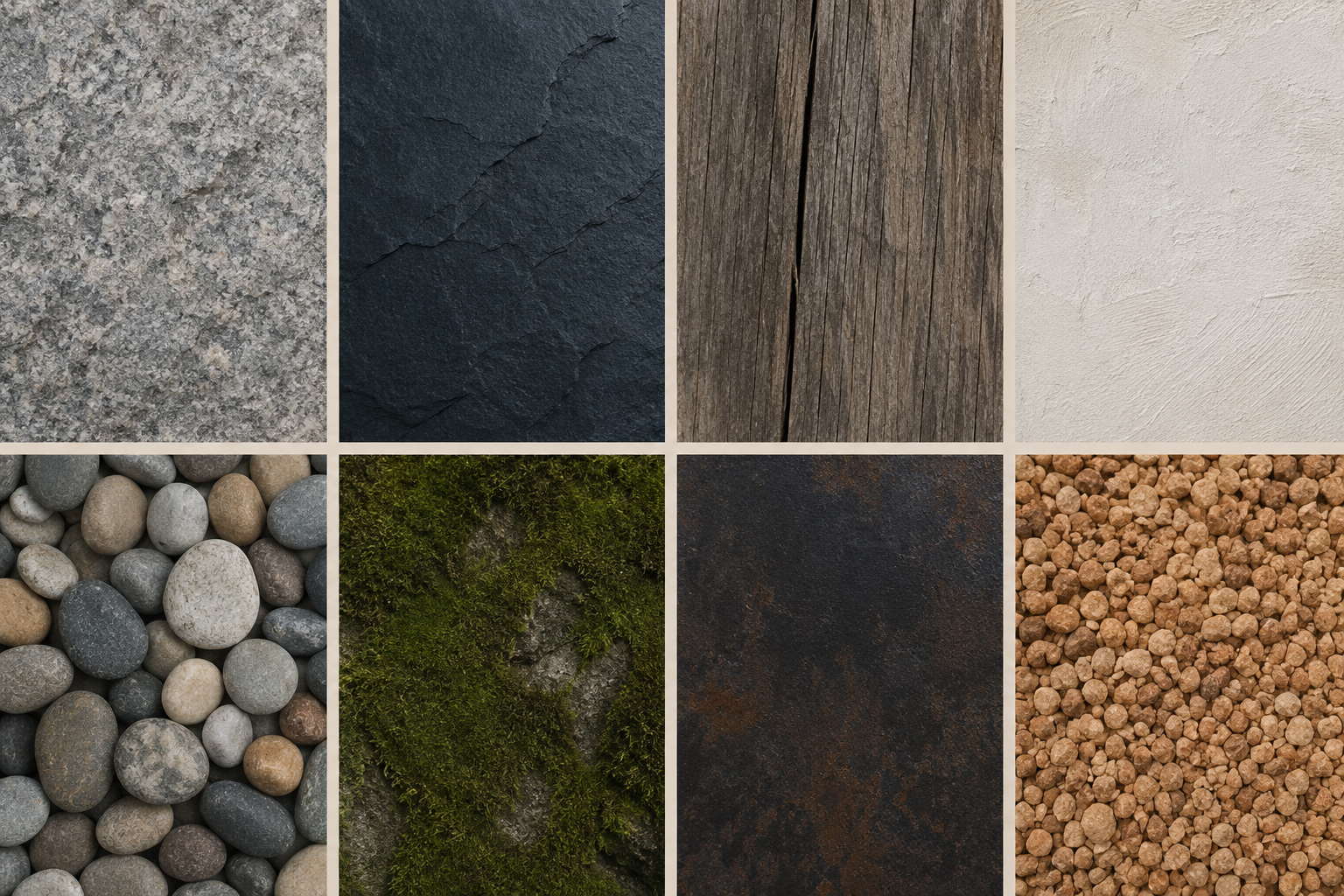
Material authenticity: choosing stone, gravel, timber and other materials for the way they weather, sit, reflect light and belong to the receiving landscape.
Botanical authenticity: using Japanese species where they are horticulturally appropriate and meaningful, while allowing local or climate-adapted plants to perform equivalent spatial roles where they are better suited.
Botanical resemblance is the least useful layer when it forces a plant to live badly. A maple that burns in the wrong exposure, an acid-loving shrub kept alive through continual intervention in alkaline soil, or an imported stone that looks foreign under local light may move the garden farther from the discipline that produced its Japanese references. Appearance matters, but it should grow from the practice and the site rather than from a checklist.
A collaboration built around respect and care
Our Japanese garden collaboration developed through conversations before there was a successful commission to attach to it. That matters to us. The exchange was never limited to a fee, a drawing package or a promise to reproduce a recognizable style. We kept returning to the same questions: what is being preserved when Japanese garden knowledge moves to another country, what should be allowed to change, and who will care for the garden after construction.
Our Kyoto-based collaborator Naoto has spent more than 25 years in Art of Japanese Garden practice. In his own explanations, gardens carry history, philosophy, religion, art and daily work together. He speaks about protecting and passing on principles, and he gives the ordinary acts of care real weight: cleaning, removing weeds, pruning, observing changes, returning to the same plant or stone through the seasons. A finished drawing does not end that responsibility.
There is humility in that position that we value. His interest in working internationally has been described to us through learning, contribution and exchange as much as through business. When language or distance can flatten a design conversation, he responds with more detail: hand drawings, written explanations, reference photographs and examples of stone composition. He welcomes revision. He is also interested in learning the digital tools that LASD uses, while we continue learning from the embodied craft knowledge that drawings can never fully replace.
This reciprocity is important. We do not want to market Japan as an aesthetic resource that can be extracted and packaged. We want the collaboration to create good work for everyone involved, to give Japanese garden knowledge a serious place inside projects in Europe and California, and to let each local landscape answer back.
The public face of the service remains LASD Studio. The Kyoto collaboration is deliberately quieter. Its value appears through the standard of the work, the questions asked during design, the way stone is handled, the pruning logic and the care regime that follows. The person behind that knowledge does not need to become a separate marketing product for the collaboration to be real.
Southern California: dry landscape under hard light
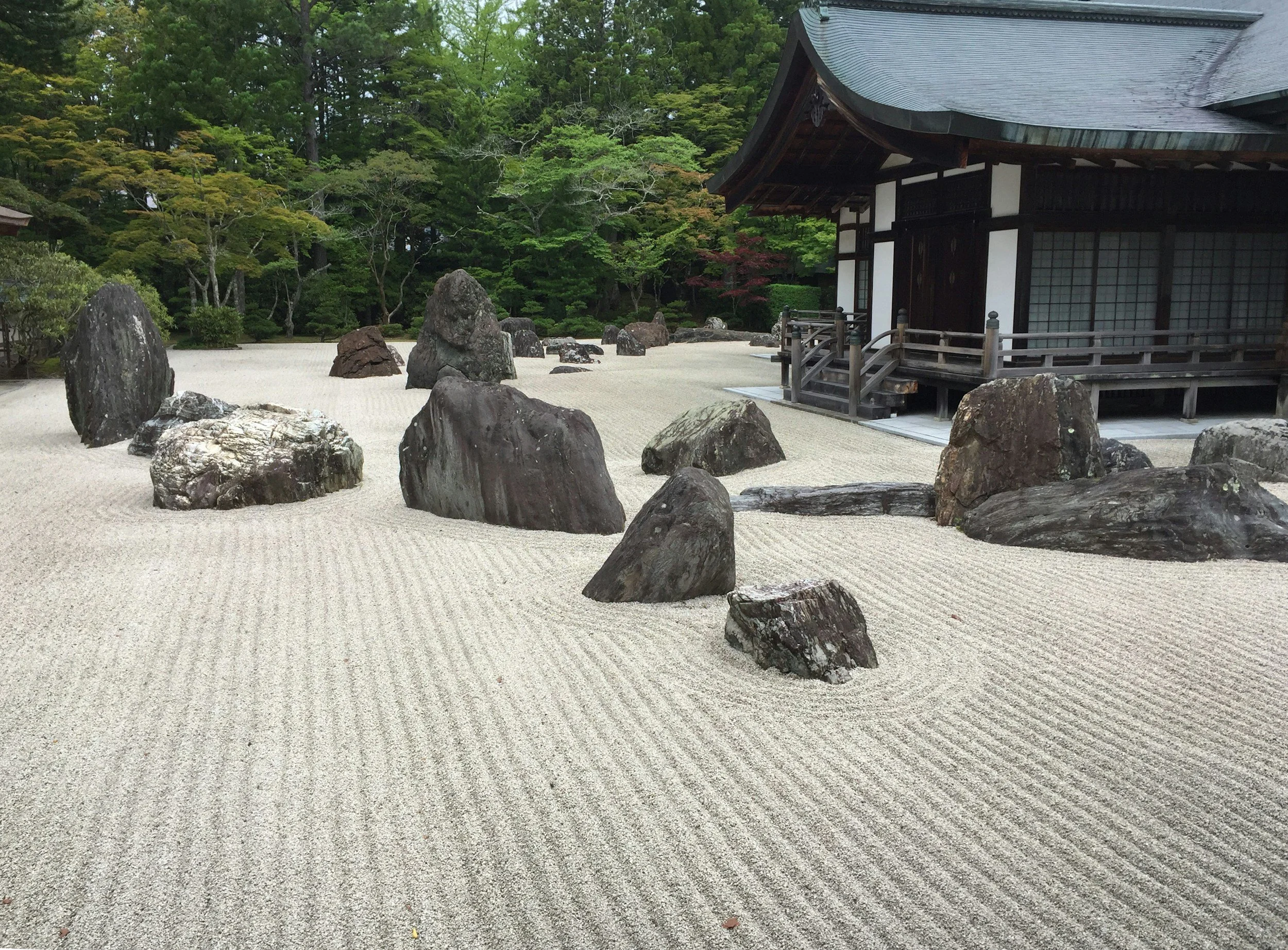
Southern California changes the material reading immediately. Kyoto gravel is usually seen under softer, more humid light. In San Diego, a very pale surface can become glaring. A warmer local granite, a coarser aggregate or a slightly darker value may carry the intended quietness more successfully because it responds to the actual sun.
Water changes the design again. California's Model Water Efficient Landscape Ordinance establishes water-efficiency requirements for regulated new and rehabilitated landscapes, and local agencies may adopt rules that are more stringent. Ponds, waterfalls and irrigated planting therefore need to earn their place technically as well as visually. A dry landscape has an obvious advantage: stone and gravel can carry much of the composition without asking potable water to perform as scenery.
Wildfire adds another layer. In fire-exposed areas, the first feet around a structure are increasingly being treated as an ember-resistant zone where non-combustible surfaces matter. The exact rule in force must always be checked with the local authority. The design opportunity is already clear. Japanese garden traditions have centuries of experience composing gravel and stone directly against architecture. A required non-combustible band can become a deliberate foreground read from the principal rooms instead of a strip of defensive rock left over after the planting plan is finished.
The rest of the garden can then work outward from shade, topography and borrowed scenery. A canyon becomes part of the composition. Existing mature trees can control glare and distance. Planting is selected by function and climate: canopy, filtered screen, evergreen structure, seasonal accent, ground plane. Japanese species may be used selectively where they genuinely thrive. The garden should never depend on horticultural stress for its identity.
Considering a landscape project?
Receive a structured outline of your project, including design direction, phases, and estimated ranges - before any commitment.
Spain contains several different Japanese garden possibilities
Spain cannot be treated as one climatic problem. The same compositional principles can lead to very different gardens in Asturias, Mallorca, Madrid and the Costa del Sol, and this difference is useful. It gives the work regional identity rather than forcing one imported image across the country.
Atlantic Spain
Asturias, Galicia, Cantabria and the Basque Country offer conditions that can come surprisingly close to the humid character of parts of Japan: frequent rain, acidic soils in many locations, moss potential, ferns, woodland edges and softened light. Camellia japonica also has a long cultural history in Atlantic Spain. Historic gardens and collections in Galicia have made camellias part of the regional landscape rather than a recent Japanese import.
Here a Japanese-influenced garden can work with what is already present. Lichened local stone, camellias, ferns, moss, woodland planting and moving water can sit inside a disciplined sequence of ma, miegakure and shakkei. An Asturian hillside or the Atlantic sky may become the borrowed scenery. Rain can feed channels and reveal the texture of stone. The garden begins to belong to the valley because the Japanese contribution is carried through composition and care.
Mallorca and Mediterranean Spain
Mallorca asks for another answer. Water is scarce, the light is sharp, and the island already possesses an extraordinary stone culture. Its dry-stone tradition, pedra en sec, is recognised internationally as living craft knowledge, and trained margers continue to build and restore the terraces that organise the island's agricultural landscapes.
A Japanese garden on a Mallorcan estate could begin with those existing terraces rather than erase them. Local limestone can be read and set through Japanese compositional principles. The Tramuntana can be borrowed as distant scenery. Water can be reduced to sound or a small basin. Olive, pine and Mediterranean evergreen structure can perform spatial roles without pretending to be a Kyoto plant palette. The result has the possibility of becoming specific enough that it could exist only on that island.
The Costa del Sol and other Mediterranean regions share the dry summer problem but bring different architecture, soils and local materials. Lime-rendered walls, courtyards, gravel and shade already provide a strong framework. Japanese spatial discipline can enter through proportion, path, stone, framed views and the handling of emptiness without turning a Spanish garden into a stage set.
Madrid and continental interiors
Madrid adds winter cold to summer heat. Enclosure and shade become especially important, which makes the courtyard and compact dry garden useful typologies. Planting has to tolerate the full annual range. Stone, controlled views and a strong architectural relationship can carry more of the identity than a fragile collection of imported plants.
Frequently asked questions ???
Does LASD Studio design authentic Japanese gardens in California and Spain?
Yes, for selected projects. LASD Studio develops the landscape architecture, site-specific design and technical delivery, with specialist Japanese garden knowledge integrated through a Kyoto-based collaborator whose practice spans more than 25 years. The scope is adapted to the site, architecture, climate, construction team and intended standard of care.
Does an authentic Japanese garden require Japanese plants and imported stone?
No universal rule requires that. Cultural and compositional authenticity can be carried through spatial sequence, stone setting, borrowed scenery, architecture, restraint and care. Local materials and climate-adapted plants are often the more responsible choice when they perform the intended role and belong naturally to the receiving landscape.
Can a Japanese garden work in a dry climate?
Yes. Karesansui, dry landscape, uses stone, gravel and controlled planting to create depth and movement without relying on a large water feature. In Southern California and Mediterranean Spain this can respond particularly well to water scarcity, strong light and the need for durable ground planes.
How involved is the Kyoto collaborator?
The collaboration is project-specific. Specialist input can include compositional review, stone selection and setting guidance, pruning strategy, material and cultural references, and the long-term care regime. LASD Studio remains the client-facing practice and coordinates the project locally.
Can a Japanese garden be low-maintenance?
The maintenance demand can be designed, but a serious Japanese garden should not be sold as maintenance-free. A stone-led garden with a restrained planting palette can require less horticultural intervention than a garden dependent on heavily trained specimens. Where trained pines, moss, clipped forms or precise gravel surfaces define the character, skilled recurring care is part of the design.
What information should a client share first?
The most useful starting material is the site location, photographs, architectural drawings, survey information where available, approximate garden area, important views, existing vegetation, known drainage or wildfire constraints, design references and an indication of the intended construction investment. From there, the first conversation can determine whether a Japanese garden is appropriate and what kind of Japanese garden the place could support.
Editorial sources, credits and supporting links:
The Use and Maintenance of Shirakawa-suna in Temples of Kyoto City, Journal of The Japanese Institute of Landscape Architecture: https://www.jstage.jst.go.jp/article/jila/78/5/78_497/_article/-char/en
Kyoto Journal, Found in Translation: Teaching the Art of the Japanese Garden: https://kyotojournal.org/gardens/found-in-translation-teaching-the-art-of-the-japanese-garden/
North American Japanese Garden Association, Japanese garden terminology and principles: https://najga.org/
Japan House Los Angeles, A Perspective on the Japanese Concept of Ma: https://www.japanhousela.com/articles/a-perspective-on-the-japanese-concept-of-ma/
Tenryū-ji official garden reference: https://www.tenryuji.com/en/precincts/
Adachi Museum of Art, Japanese Gardens: https://www.adachi-museum.or.jp/en/gardens
California Department of Water Resources, Model Water Efficient Landscape Ordinance: https://water.ca.gov/Programs/Water-Use-And-Efficiency/Urban-Water-Use-Efficiency/Model-Water-Efficient-Landscape-Ordinance
California Board of Forestry and Fire Protection, defensible-space and Zone 0 materials: https://bof.fire.ca.gov/projects-and-programs/defensible-space-zones-0-1-and-2
UNESCO Intangible Cultural Heritage, Art of dry stone walling, knowledge and techniques: https://ich.unesco.org/en/RL/art-of-dry-stone-walling-knowledge-and-techniques-01393
Consell de Mallorca, dry-stone work and Escola de Margers: https://caminsdepedra.conselldemallorca.es/en/dry-stone-work
Turismo de Galicia, Ruta da Camelia: https://www.turismo.gal/que-facer/ruta-da-camelia/variedades-da-camelia?langId=es_ES