
The Pearl of the Sea - A Nautical Garden in San Diego
A coastal-inspired garden that captures the beauty of underwater life through coral-like planting, sculptural concrete, and sustainable San Diego elegance.
The Pearl of the Sea - video presentation of Mid-Century Modern Landscape Architectural Design
Location: Point Loma, San Diego, California
Project Type: Private Residential Garden, Style- Mid-century Modern, Theme garden - Beach life and Littorals Gardens
Design Scope: Concept development, Hardscape design, Irrigation, Drainage, Breath wall design, Lighting plan design, Stormwater Planning, Construction Documentation
Status: Built / Installed
Construction: Project Management & Planting Plan - John Beaudry, Contractor - Landscape and Beyond, Jeff Miller
Construction cost: $260,000
Design Studio: LASD Studio
Concept & Vision
The clients dreamed of a garden that would let them feel the ocean every day, its colors, textures, and rhythms, right outside their front door. Inspired by their love for the sea, LASD Studio designed The Pearl of the Sea, a coastal-themed landscape that mimics the beauty and harmony of underwater life. This garden blends artistic composition, ecological sensitivity, and innovative hardscape detailing to create one of the most distinctive front-yard landscapes in San Diego. As a freediver deeply in love with the ocean, LASD Studio’s principal Yura Lotonenko immediately envisioned how this garden could embody the serene, living world beneath the waves - transforming that vision into an expressive and sustainable landscape experience.


~ Where breath of the Ocean meets free Spirit ~
Design Narrative
This garden is conceived as a living coral reef emerging from land, a poetic transition from ocean depth to coastal terrain. Each element, from planting to material texture, was carefully chosen to echo the forms and rhythms of marine ecosystems, creating a place that is both sculptural and sustainable.
Concept: Coral reef landscape, a terrestrial expression of the ocean’s life forms,
Theme: Regenerative coastal minimalism with sculptural hardscape detailing,
Location: San Diego, California.

Conceptual Sketch — Coral Planting: The Dream Behind The Pearl of the Sea
Hardscape & Materials - State of Art
The hardscape establishes the primary order of the garden; a continuous surface that carries movement, defines edges, and anchors the experience.
Concrete forms the ground plane.
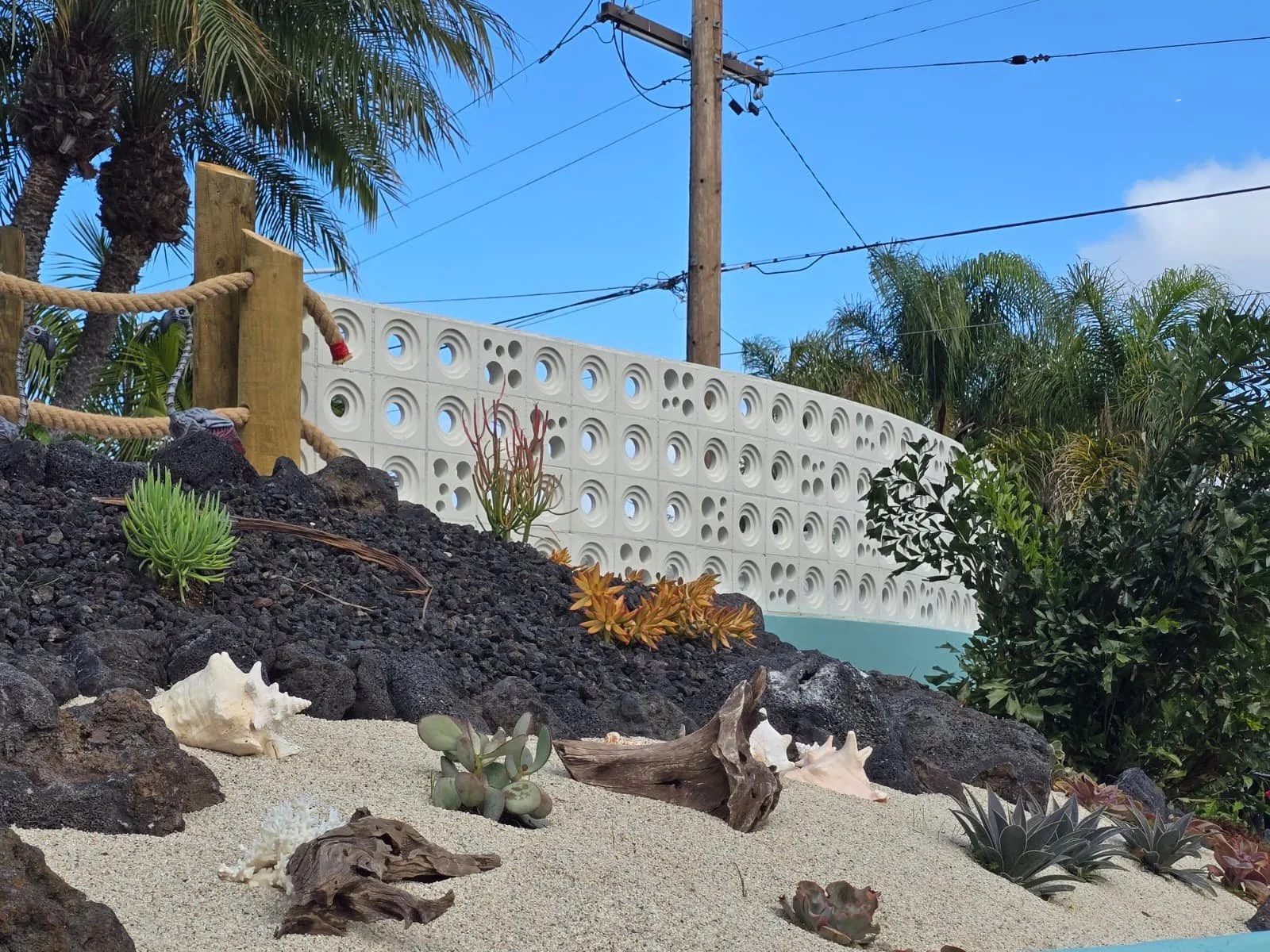
Poured in long, uninterrupted lines, it extends through the site with a controlled smoothness; within it, aggregated glass is set into the surface, catching light and reflecting it subtly, like fragments beneath shallow water. The effect is not immediate. It reveals itself as you move.
Along the perimeter, a lighter boundary condition is introduced.
Timber posts hold a line without closing it; rope spans between them, softening the edge while maintaining safety. The material responds to touch and weather, shifting over time, remaining consistent with the coastal atmosphere without becoming literal.
A vertical element emerges as a porous wall.
Composed of repeated circular blocks, it filters light rather than stopping it; shadows pass through and change throughout the day, creating a second layer of movement across the ground and adjacent surfaces. The wall holds space while allowing air and light to continue.
Stone is introduced in contrast.
Lava rock gathers in irregular formations, rising slightly from the ground plane, creating moments of density and depth. These elements interrupt the continuity of the surface, offering texture, shadow, and places where the garden begins to thicken.
Finer material is placed closer to the ground.
Shell fragments, driftwood, and coral pieces settle into gravel and sand, not as decoration, but as a change in scale; a transition that draws attention downward, completing the composition through detail rather than emphasis.
Together, these materials do not compete.
They operate as a system; continuous, responsive, and grounded in both structure and atmosphere.
Planting Design
The planting palette was composed to mimic aquatic organisms through color, texture, and form, a living sculpture inspired by coral ecosystems.
Succulents & agaves simulate coral colonies and anemones, thriving in the dry coastal microclimate.
Sedums, echeverias, and mangaves provide fine textures and pastel tones, creating a vibrant undersea color gradient.
Tropical palms and cycads anchor the composition, representing the “surface canopy” and adding vertical drama.
CA native and low-water species ensure sustainability and resilience while maintaining the coastal theme.


The Pearl of the Sea stands as a unique fusion of landscape architecture, art, and ecology - a front yard transformed into a coastal sculpture garden, celebrating San Diego’s maritime spirit. It reflects LASD Studio’s philosophy of designing landscapes as evolving, living systems that tell stories, heal land, and connect people with nature’s deeper rhythms.
This garden is more than a landscape, it is a therapeutic retreat designed to restore balance, spark joy, and create lasting memories. Every element is thoughtfully composed to provide a sense of refuge, rejuvenation, and inspiration.
Landscape Design Project Process & Realization
Creating The Pearl of the Sea was an immersive, six-month journey from concept to completion.
The project began with over three months of dedicated design work: from on-site measurements and client meetings to concept sketches, planting studies, and full technical documentation. Every detail was refined with precision and artistry to ensure that the final result would feel alive, like a coral reef breathing on land.
Construction spanned another three months, involving a team of exceptional craftsmen, artisans, and landscape specialists - people who share LASD Studio’s passion for design, precision, and care for both the vision and the client experience. Every material, texture, and planting placement was handled with deep attention to the project’s soul.


Value & Impact
The Pearl of the Sea transformed the property at 2372 Plum Street, San Diego, into a work of living art - a landscape that redefines curb appeal and architectural identity. Designed and built with a total construction value of approximately $240,000, the project seamlessly merges craftsmanship, ecology, and mid-century modern artistry. Beyond its beauty, the design significantly enhances the property’s market and cultural value, positioning it as one of the most distinctive front yards in the area. It stands as proof that visionary landscape architecture not only enriches daily life, but also becomes a long-term investment in both art and property.