
Rancho Santa Fe Rewilding Landscape Architectural Design
“A Living Legacy: Proudly Designed as an Evolutionary Landscape for Future Generations.”
This project reflects a direction I’ve been developing since 2008: gardens designed as living ecosystems - resilient, biodiverse, and intended to evolve for decades.
In Rancho Santa Fe, where water, wildfire risk, and ecological fragmentation are no longer abstract issues, a garden can either become a fragile surface that demands constant control - or it can become a living system that grows more resilient with time. The Rancho Santa Fe Rewilding Sanctuary Garden was designed as the second kind: a legacy-level ecological landscape that reconnects beauty with function, and elegance with reality.
Created by LASD Studio in collaboration with The Image of Nature, the design rethinks the property as an evolving habitat. It is structured to reduce wildfire vulnerability, regenerate biodiversity, and restore the “biological intelligence” of the land: from soil microbes to pollinators, birds, reptiles, and the predator presence that stabilizes an ecosystem over the long horizon.
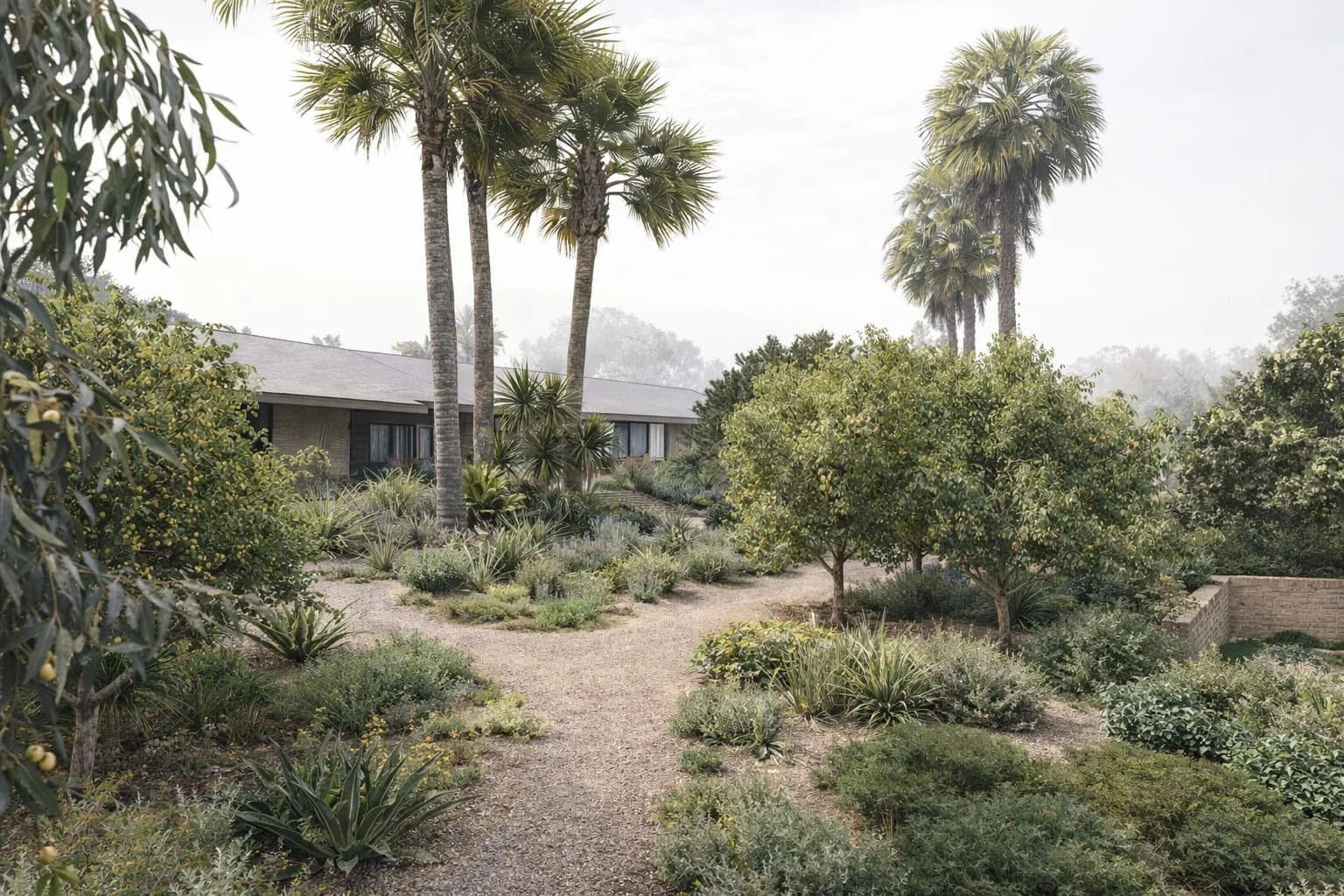
Location: Rancho Santa Fe, California
Project Type: Ecological restoration, per fire-defensible code. Evolving Estate Landscape and Ecological restoration
Design Scope: Concept development, Hardscape design, Irrigation, Drainage, Breath wall design, Lighting plan design, Stormwater Planning, Fuel Modification Plan, Soil and vegetation restoration, Construction Documentation.
Construction cost: $1,260,000
Code compliance & Landscape Architect in Record: Glen Sharrar, The Image of Nature
Fire department: Conor Lenahan, Rancho Santa Fe, Fire Protection District.
Soil testing lab: Wallace Laboratories & Waypoint Analytical
Construction and Fire cleaning: by Client
Design Studio: LASD Studio - Landscape Architecture, Sustainability & Design
A concept exploring how this garden could evolve over time.
Read more about research behind this garden - SoCal Wildlife and Biodiversity Landscape Restoration.
‘Rewilding Sanctuary Garden’, A Living Legacy: Designed as an Evolutionary Landscape.
Concept & Vision
This is not a native garden in the simplistic sense of replacing exotics with natives. It is a designed ecological structure - shaped by fuel modification constraints, drought realities, and the desire to create a property that feels calm, refined, and fully intentional, while also functioning as habitat.
The landscape is organized through a connected system of fire-resilient circulation routes, habitat-based planting typologies, micro-graded landforms that slow and infiltrate rainwater, and a soil restoration strategy that treats biology as foundational infrastructure. The goal is not a single “final image.” The goal is a trajectory: a landscape that becomes stronger, richer, and more self-supporting over time.
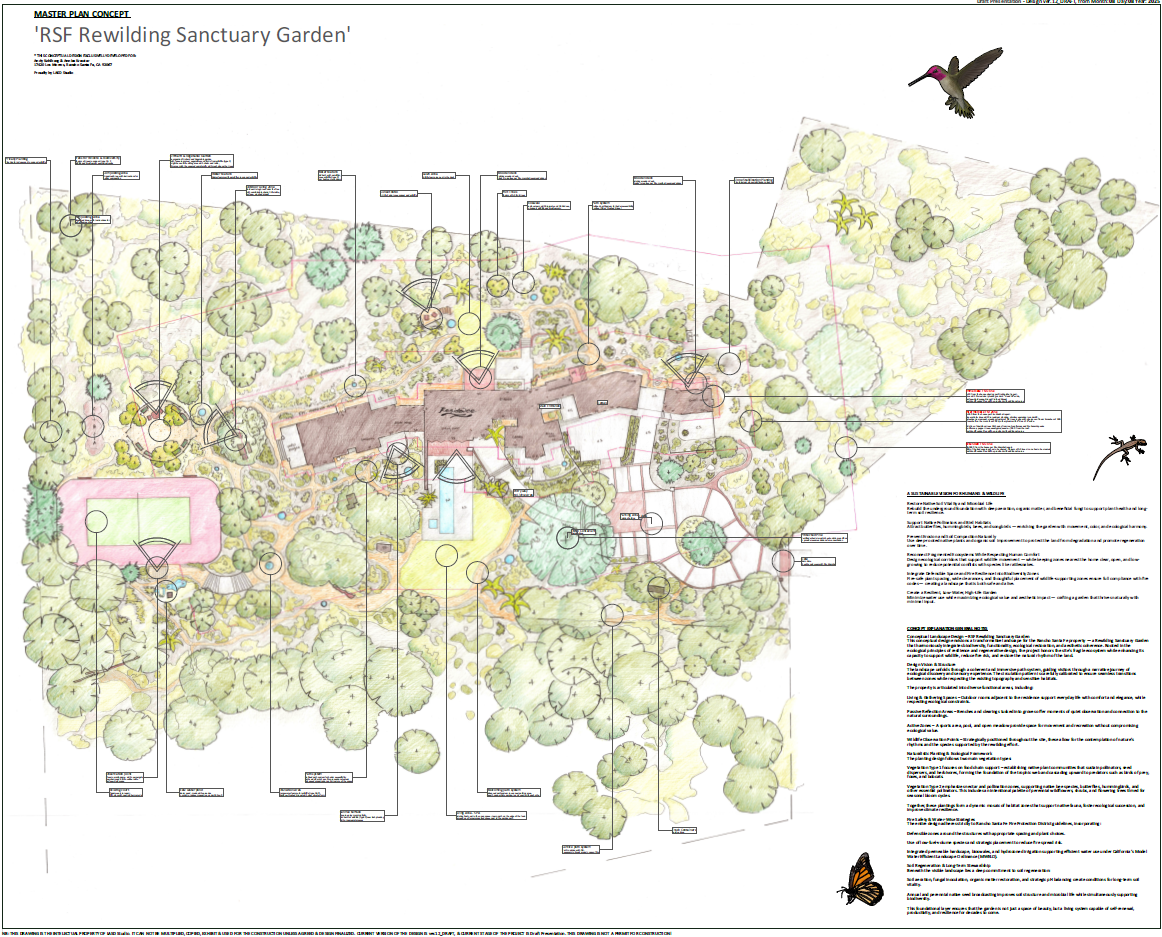
Conceptual Design Sketch, Phase 1. Design
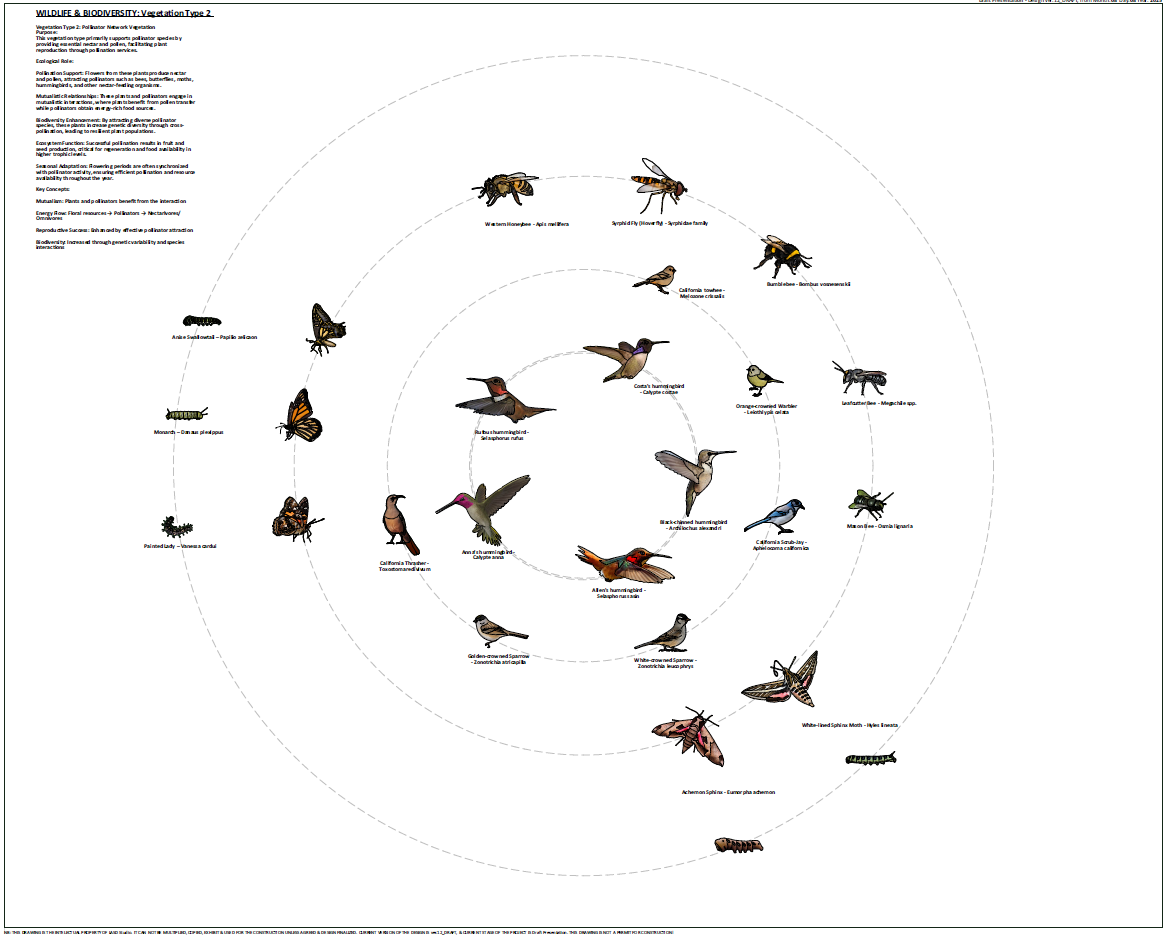
Wildlife and biodiversity, trophic layer establishment of pollinators.
Renderings
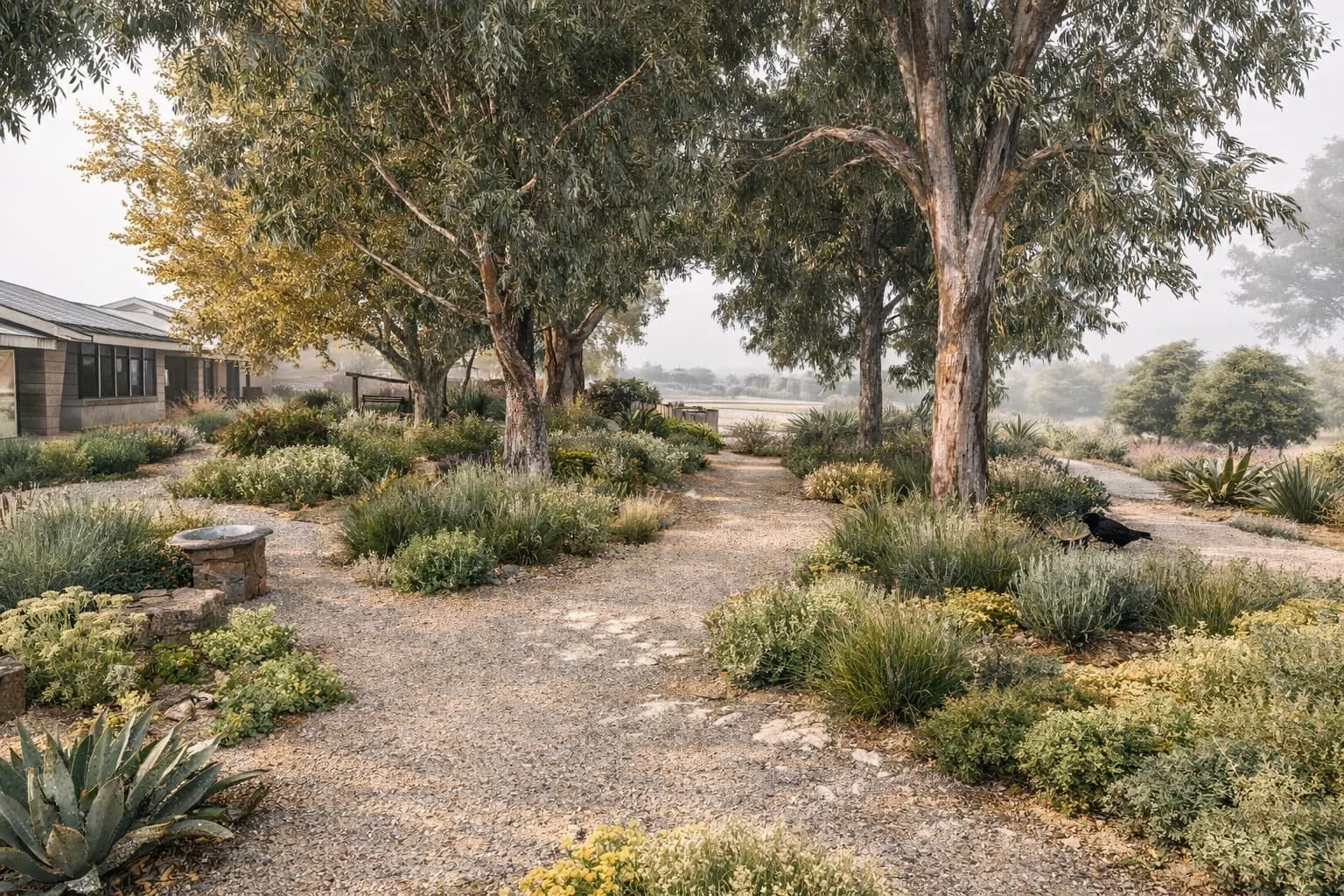
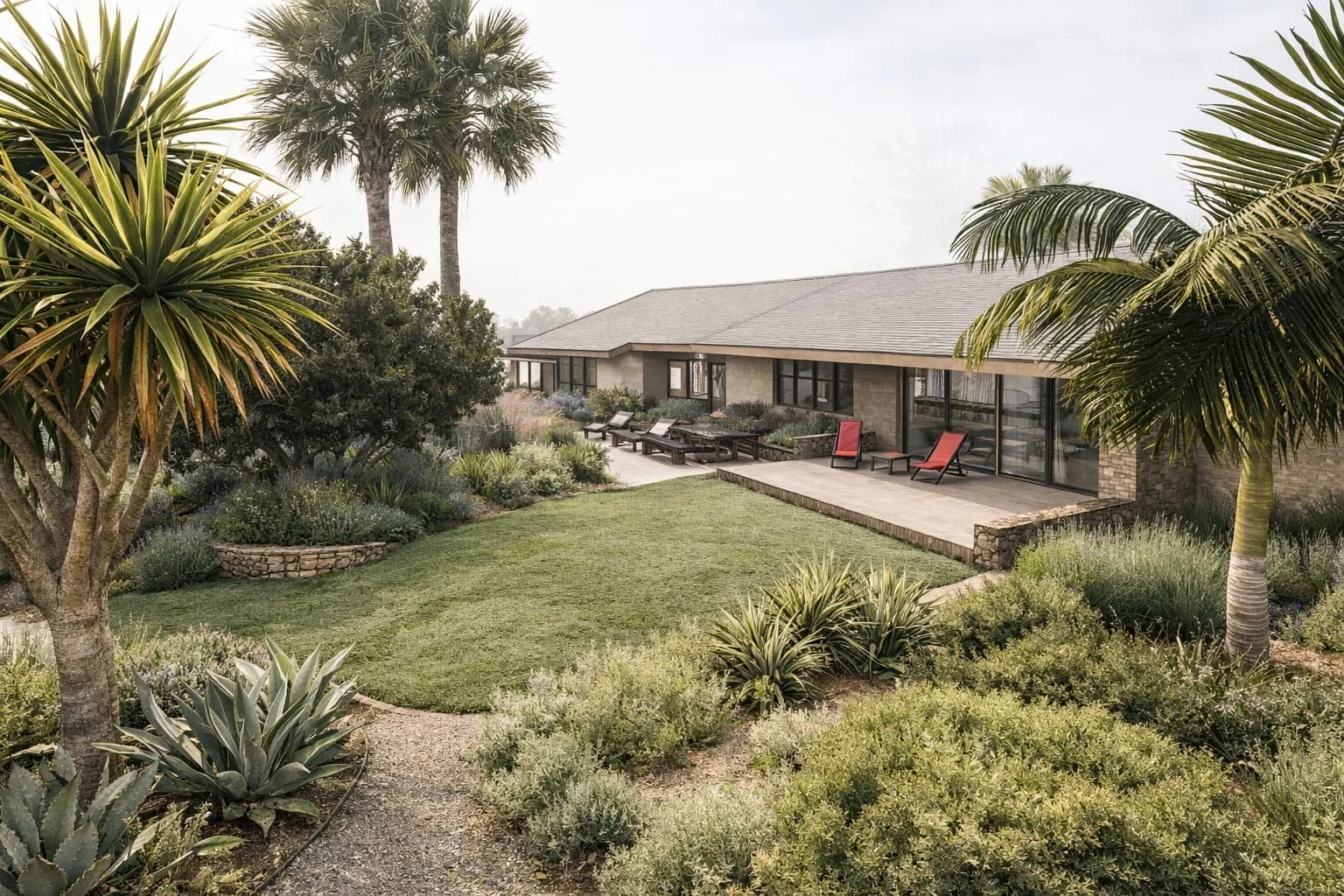
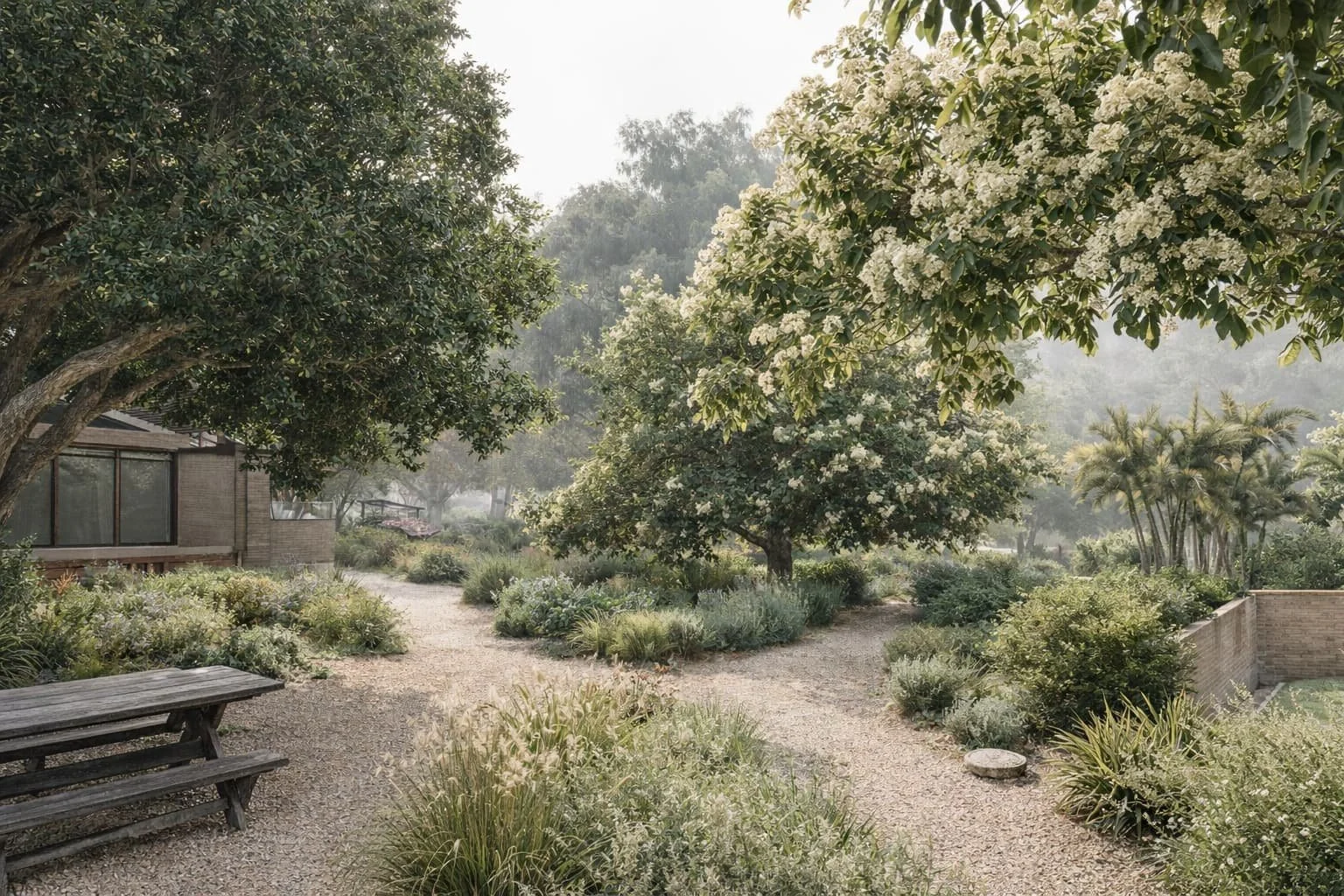
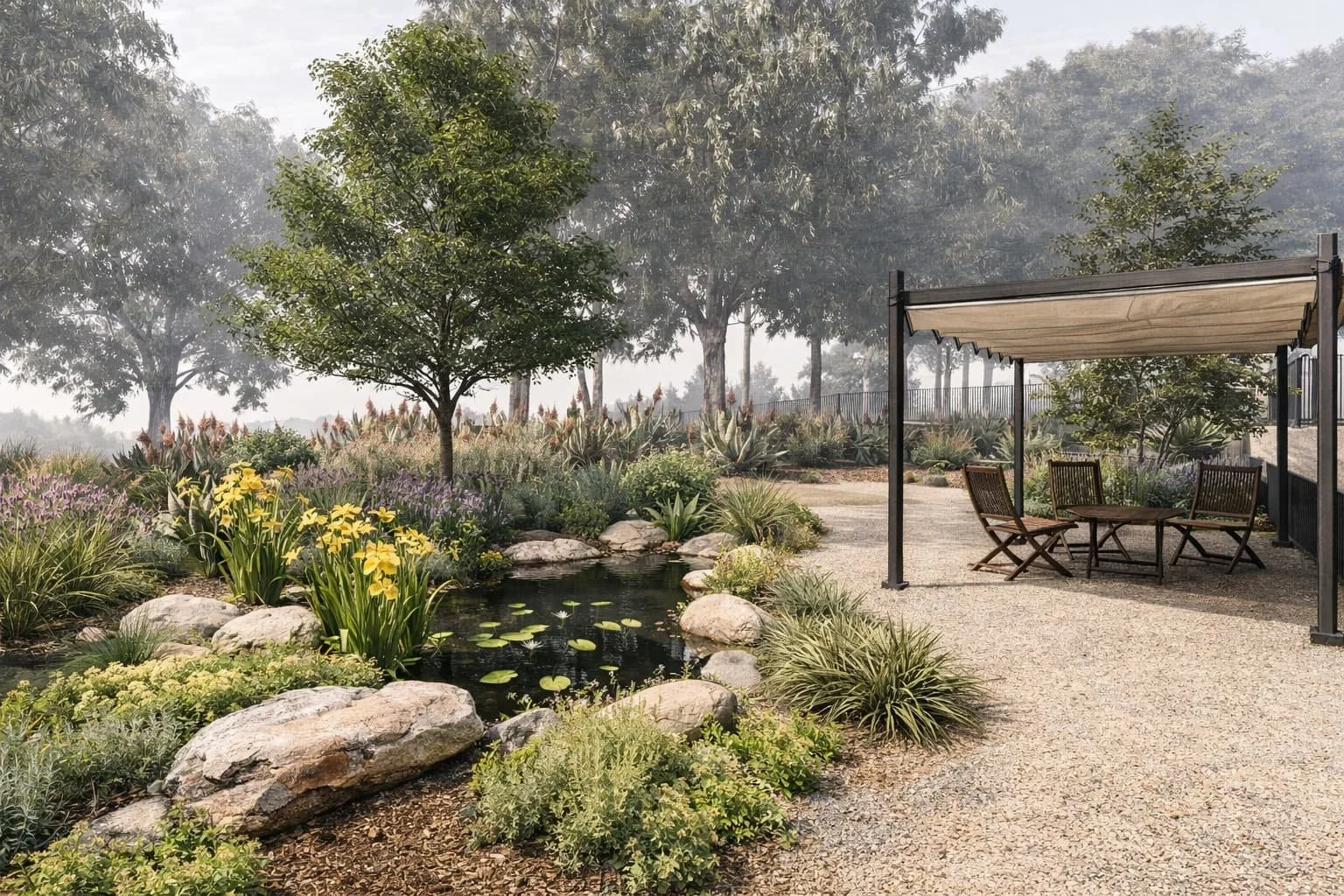
The renderings on this page show the intended atmosphere and spatial experience: the way paths become calm firebreaks rather than defensive strips, the way planting masses are shaped as habitat edges, and the way water harvesting can be expressed as landform rather than hidden engineering. These images are not “promises of identical outcomes.” They are a clear design intention - the direction the project is moving toward.
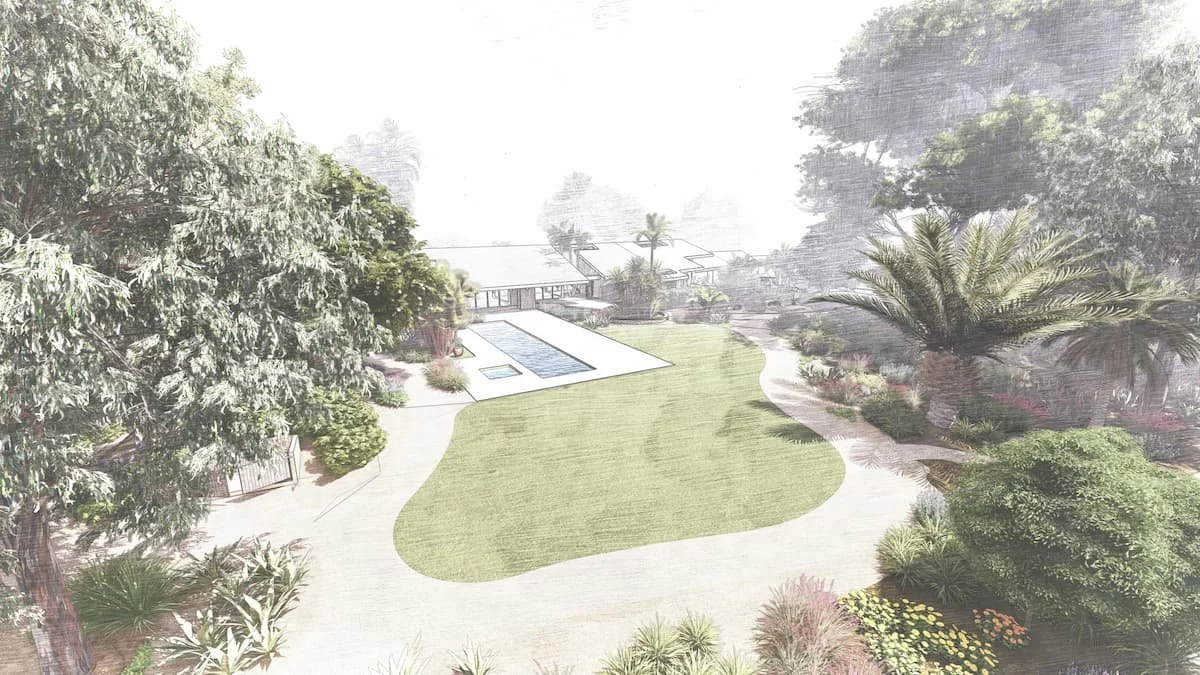
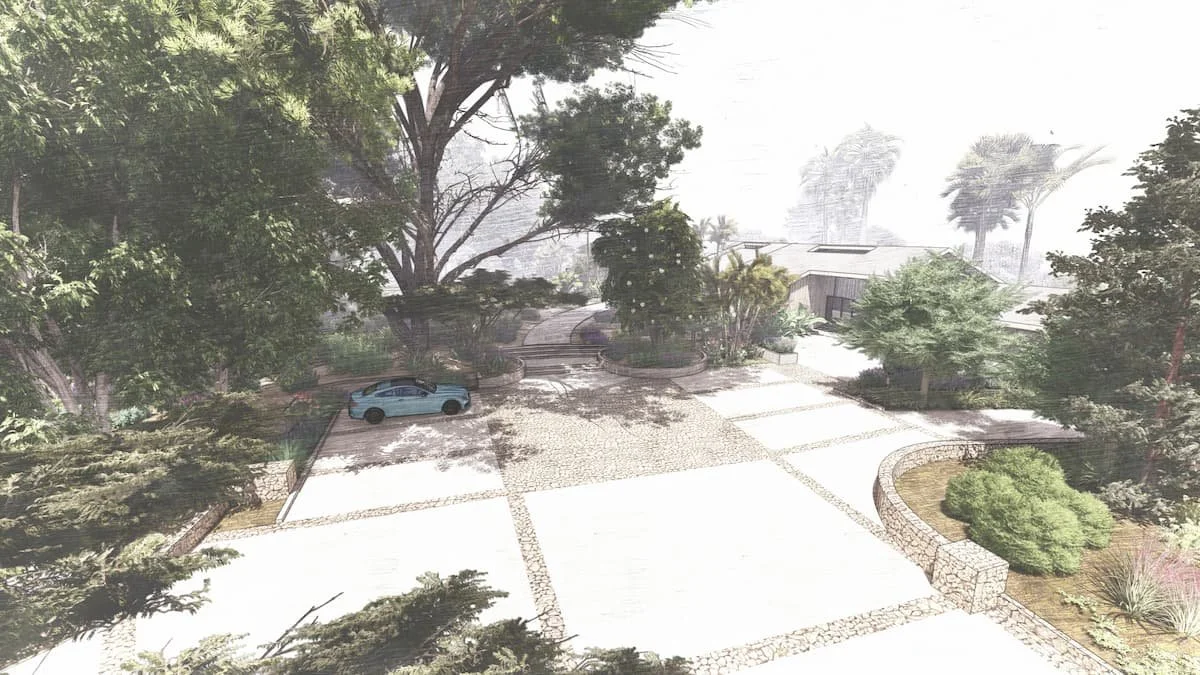
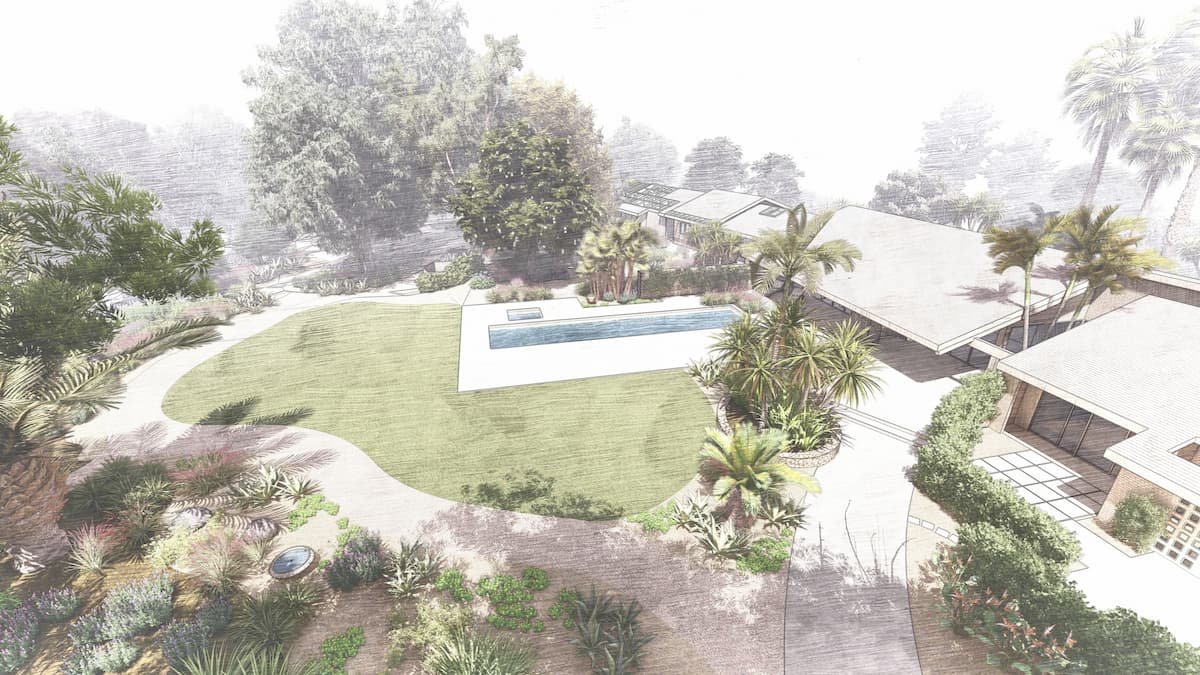
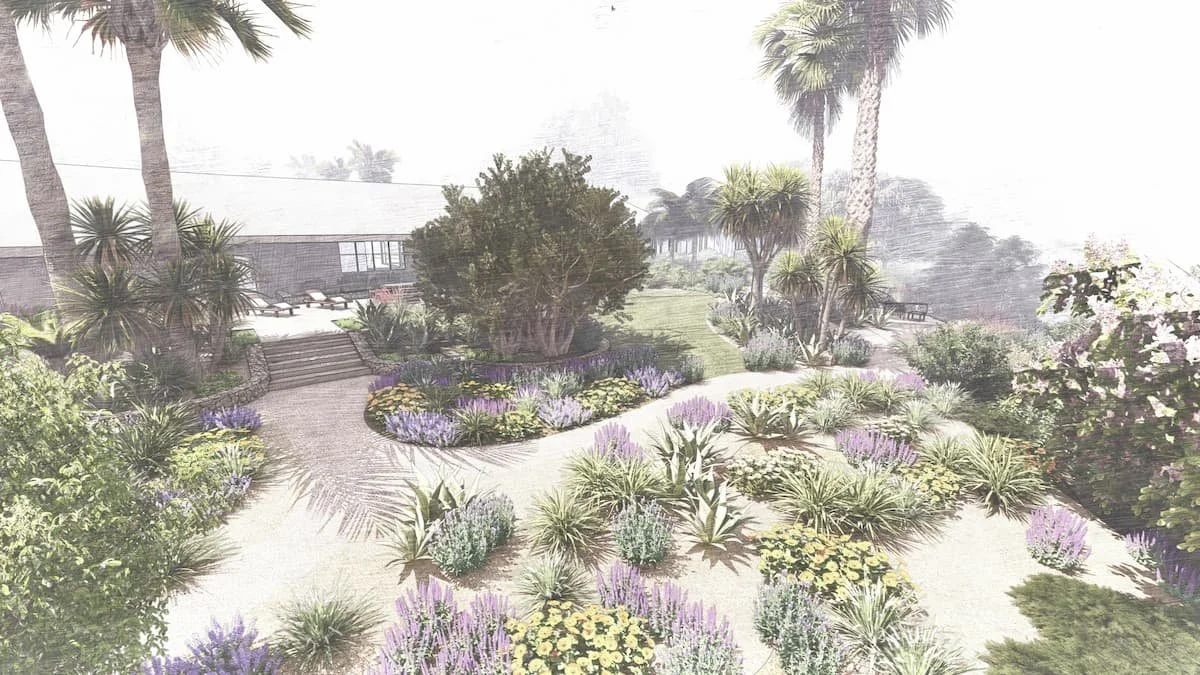
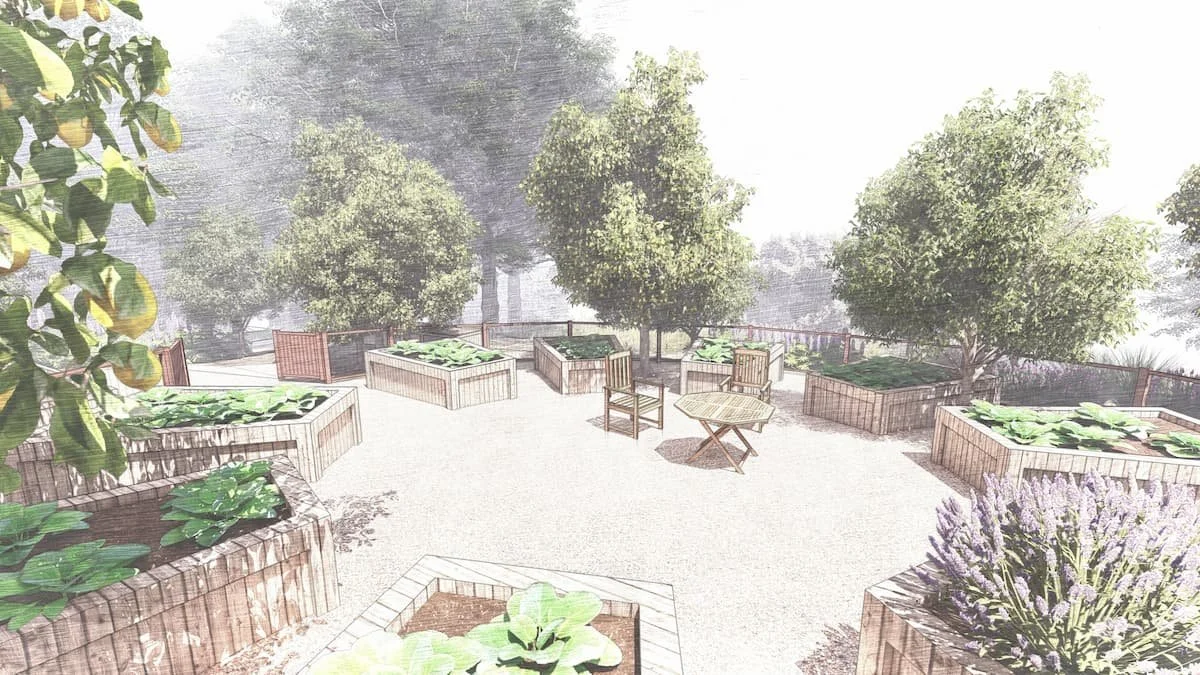
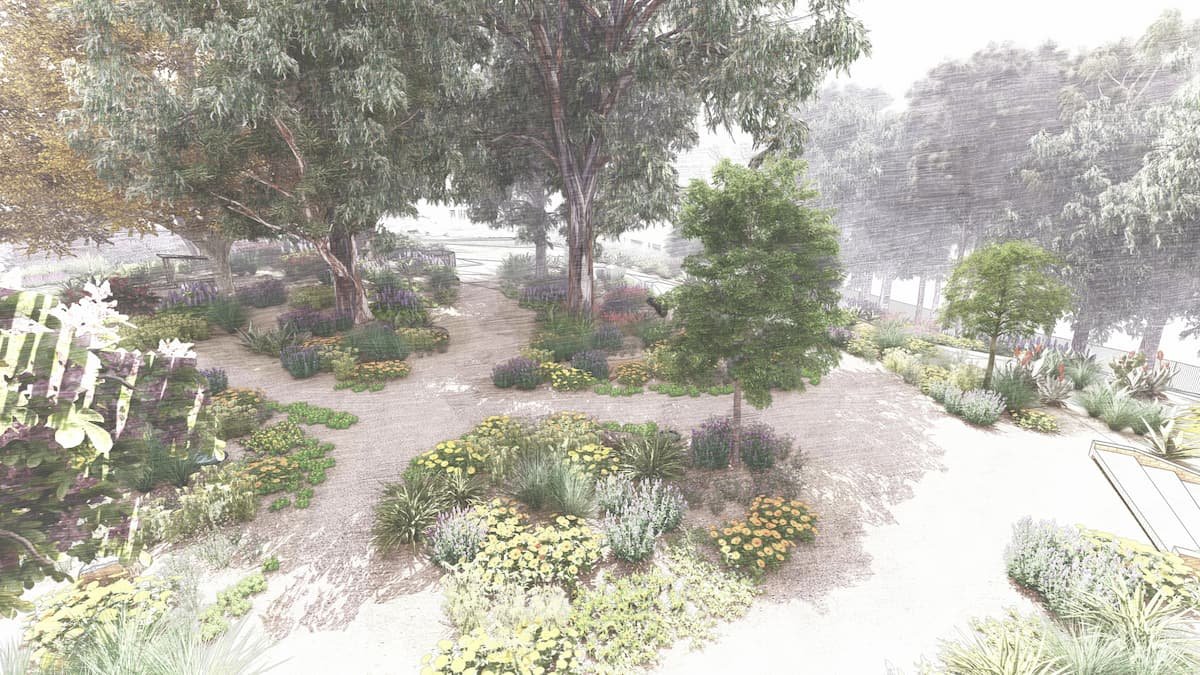
The drawings included here are selected to communicate something most portfolio pages avoid: how the landscape is actually structured to perform.
The master plan provides the overall composition and intent. The fuel modification plan shows how risk constraints become a coherent spatial framework. The grading and bioswale strategy demonstrates how water is slowed, absorbed, and redistributed across the site. The hardscape plan focuses on constructable geometry, circulation logic, and the materials that make the landscape durable. The wildlife and biodiversity diagrams show the habitat logic in a way that is visually legible, and the soil restoration concept explains the phased approach that allows a living system to establish with stability rather than fail through rushed planting.
Context: Why Rancho Santa Fe landscapes must evolve?
Southern California estate landscapes exist inside a set of pressures that continue to intensify: longer dry seasons, rising water costs, greater wildfire volatility, and shrinking habitat continuity. In many high-end properties, the default landscape model still assumes stable climate conditions and unlimited maintenance. That model is becoming fragile.
This project responds by designing the property as an ecological system with structure. It does not rely on heavy irrigation to force appearance. It does not rely on plant novelty as the main aesthetic driver. Instead, it builds a framework where water, fire, biodiversity, and human use are designed together so that each layer supports the others.
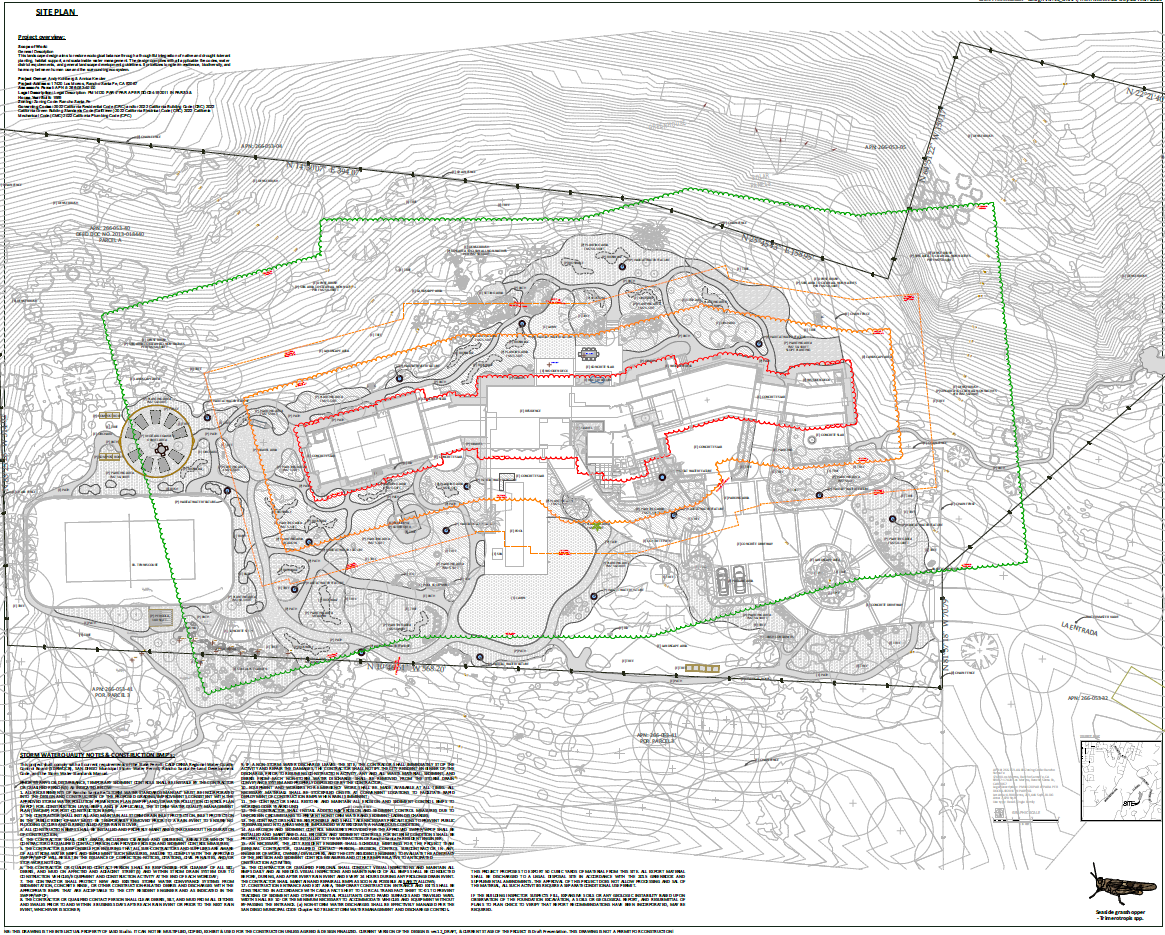
Wild-fire prevention strategy & Design narrative coordination
Fuel modification as design structure, not compromise to the design
Fuel modification requirements often produce landscapes that feel stripped, defensive, and ecologically empty. The design approach here treats fuel modification zones as a framework that can still carry beauty - and can still carry habitat.
Rather than thinking of fuel zones as something that is “drawn over” the design at the end, the zones shape the design from the beginning: how planting is spaced and layered, where circulation routes become natural firebreaks, how maintenance access and visibility are resolved, and how the transitions between zones remain soft instead of abrupt. When this is done correctly, compliance does not erase atmosphere. It becomes part of the logic of the place.
Water harvesting through grading and bioswales
In many landscapes, water is treated as a utility delivered through irrigation. In this project, water is treated as something the land can hold and distribute intelligently - especially during episodic rain events that, if unmanaged, become erosion and loss.
The grading concept is designed to slow runoff, support infiltration, and create subtle moisture gradients across the property. Bioswales are not only technical devices; they become landscape form, shaping planting conditions and supporting microhabitats. Over time, this shifts the site away from dependency and toward resilience.
Soil restoration: biology as infrastructure
A rewilding garden cannot be built on dead soil.
Soil here is treated as living foundation. The restoration approach is phased: stabilizing conditions, improving aeration and structure where needed, introducing and supporting microbial life, and using pilot planting as a feedback loop before scaling larger planting areas. This reduces risk, improves long-term performance, and allows the landscape to establish as a system rather than as a fragile composition that requires constant correction.
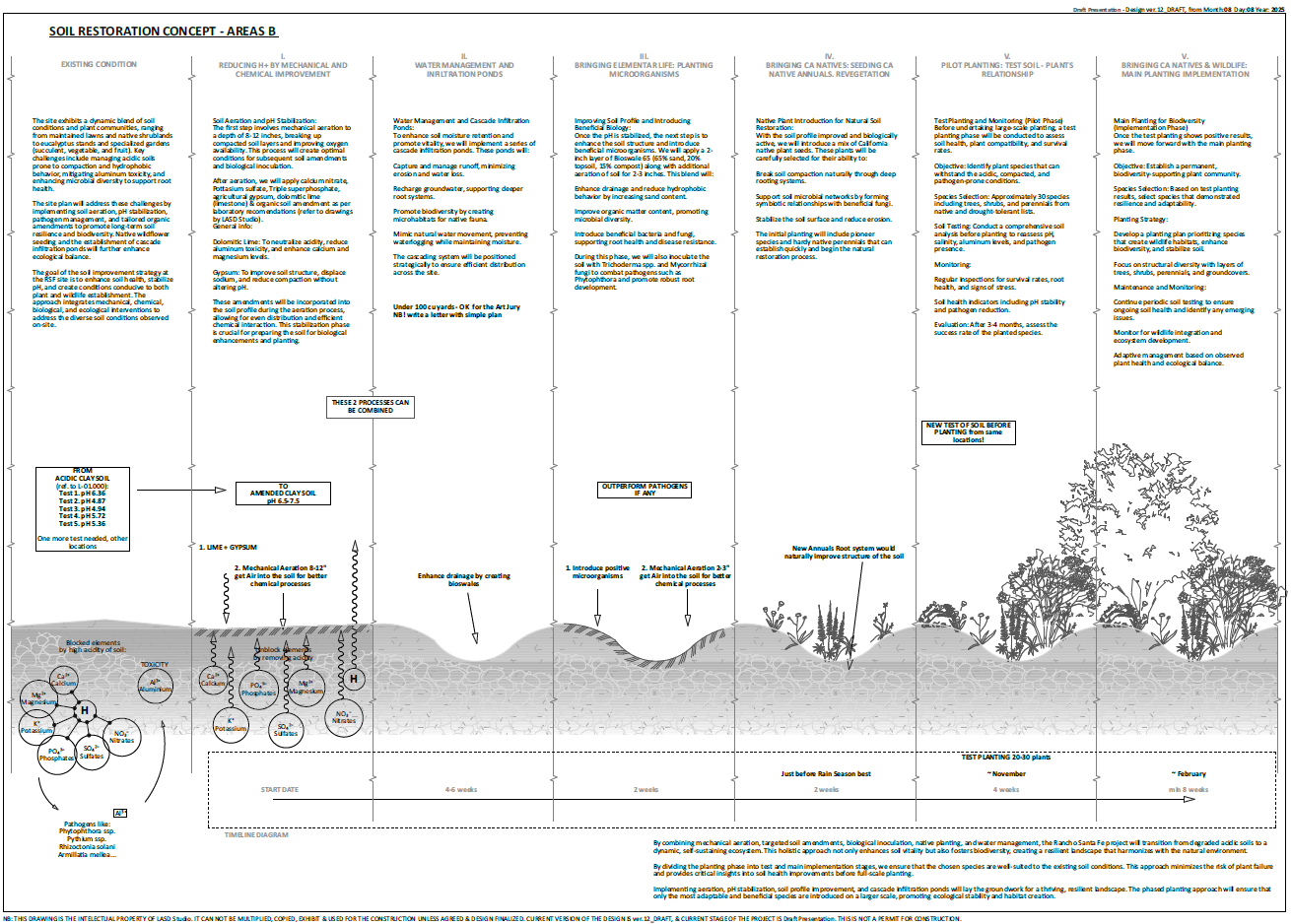
Soil restoration strategy for a long time sustainable development of life
Planting typologies based on habitat and trophic stability
Instead of organizing the planting as a list of species, the project organizes planting as a set of typologies - each with an ecological role.
Some planting zones are structured for trophic network stability: shelter, food chain support, nesting opportunities, and the layered complexity that allows multiple species to coexist. Other zones are structured specifically for pollinator continuity, supporting hummingbirds, bees, butterflies, and seasonal nectar/pollen presence through time. The result is a landscape where biodiversity is not decorative; it is functional and intentional.
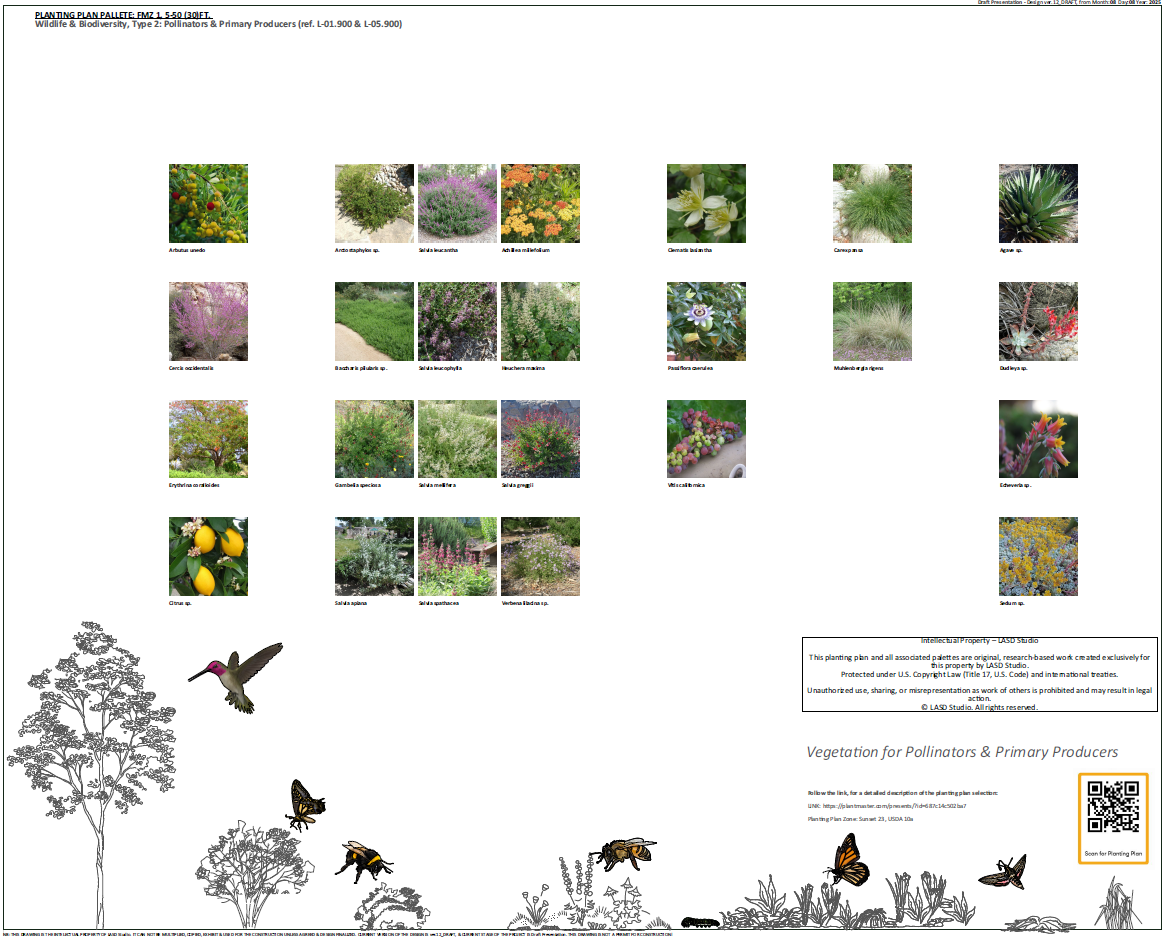
1 of 3 different wildlife and biodiversity specific planting design
Hardscape: elegance that does real work
Hardscape in this project is not separate from ecology. Paths and terraces are designed as both human circulation and risk-aware structure. In fire-prone landscapes, circulation can become strategic firebreak logic without ever feeling like a “fire plan.” When done with care, these routes feel natural and calm — and they are also practical, durable, and buildable.
This is the core LASD Studio approach: maximum ecological performance without losing architectural clarity.
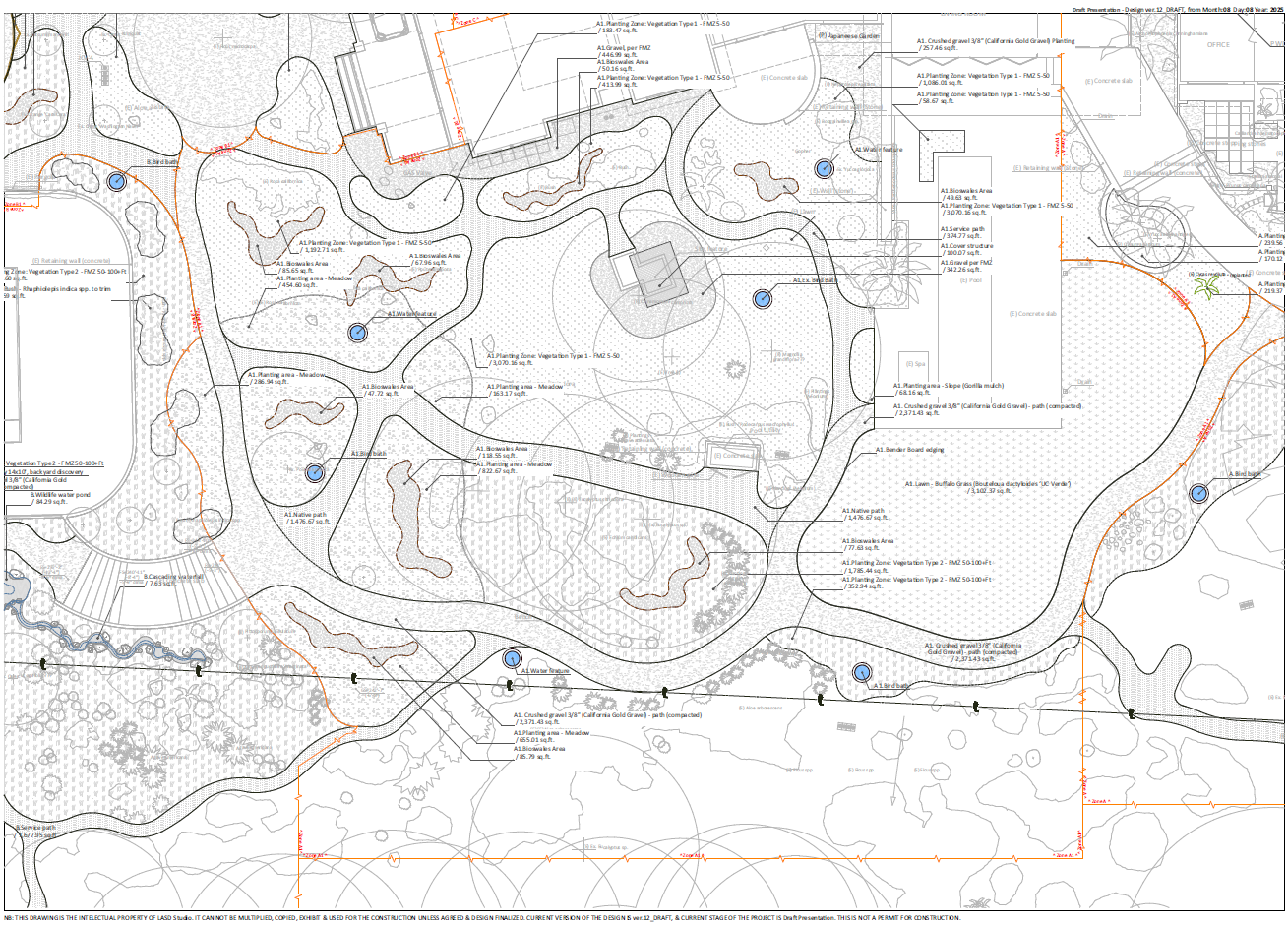
Hardscape, site plan layout
A note on maintenance
A landscape like this does not necessarily require more maintenance - but it requires a different kind of maintenance.
The establishment phase matters. Early monitoring matters. Selective pruning and zone-appropriate upkeep matter. Over time, when the system is structured correctly, the landscape becomes more stable and less wasteful than ornamental landscapes that depend on constant irrigation, constant replacement, and constant aesthetic control.
The Rancho Santa Fe Rewilding Sanctuary Garden is a blueprint for how high-end landscapes can evolve: not into scarcity aesthetics, and not into ecological performance that sacrifices beauty, but into environments where science, atmosphere, and long-horizon resilience exist as one coherent design.
If you are considering a legacy-level landscape in Rancho Santa Fe or coastal Southern California, LASD Studio can share process, phasing, and feasibility during consultation.
Learn more about LASD Studio research - https://www.lasdstudio.com/research