
Four landscapes. One discipline - see before you design.
After years of practice across continents, I keep arriving at the same starting point: see, observe, learn, listen - before you touch the landscape.
It sounds obvious. It rarely is practiced. "Water-wise" has become shorthand for a look - gravel, cactus, a handful of drought-tolerant natives arranged where a lawn used to be. That look treats water as the enemy and the landscape as a liability to be minimized. At LASD Studio we start somewhere else. A landscape is a living, evolving system, not a finished image - water, shade, soil and species are not separate problems to be solved one at a time, but interdependent parts of the same organism. Reduce water use without understanding that system, and you don't get a more resilient garden. You get a thinner one.
Four projects, an ecological estate in Rancho Santa Fe, a family garden in Laguna Niguel, a private retreat in Mallorca, and an HOA community in San Diego - show what happens when water efficiency is treated as a design discipline, not a subtraction exercise.
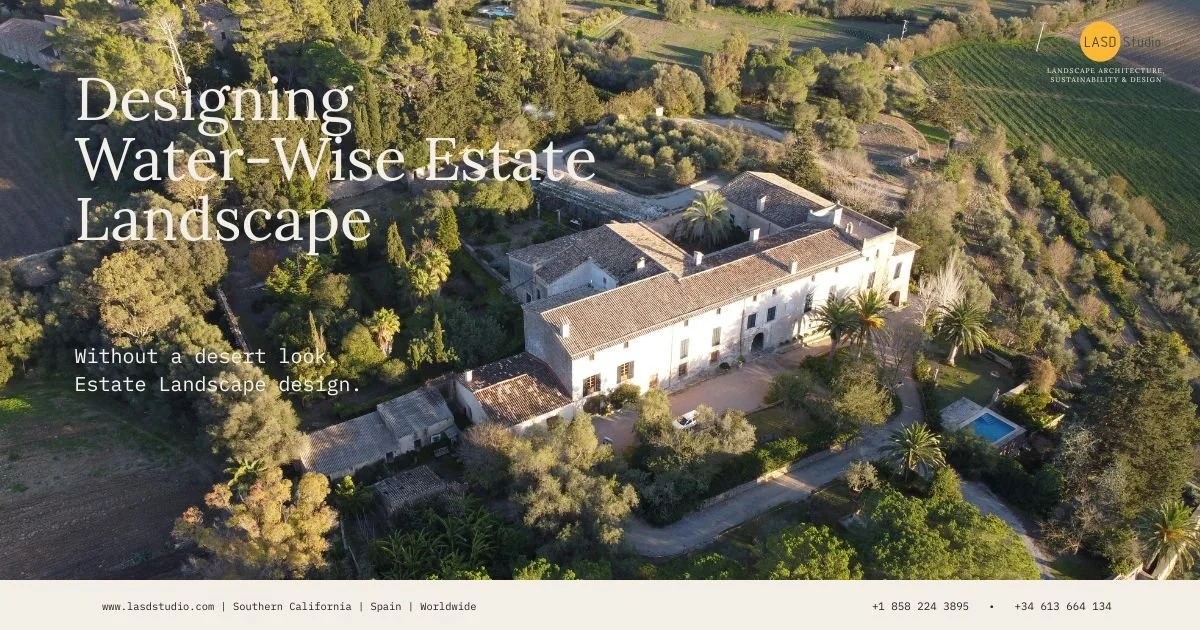
The Landscape of Estate Is a System
Water budget. Canopy. Planting. Irrigation. Soil.
Most water-reduction projects begin with an instruction: remove the lawn, plant something drought-tolerant. That may shrink the irrigated area, but it never answers the actual question - why is the property using too much water, and will whatever replaces the lawn actually perform any better?
We begin instead by mapping the property as a working system: how each outdoor space is used, where irrigation is leaking or overspraying, which mature trees and planted areas already earn their water, which lawn is functional and which is inherited habit, and where soil, shade and planting density could be doing more of the work currently being done by the hose. Only once that picture exists does LASD's in-house irrigation-design system calculate a proposed annual water demand in gallons — a forecast built from real hydrozones, controller assumptions and site conditions, not an invented before-and-after percentage. Where California projects trigger the state's Model Water Efficient Landscape Ordinance, we treat MWELO as a technical floor to coordinate around, not the design itself.
Five levers determine whether any of this performs: the water budget, the canopy and shade it sits under, the planting it feeds, the irrigation that delivers it, and the soil that decides whether the water stays or runs off. Change one without understanding the other four, and the landscape will still waste water - it will just waste it more expensively.
None of these relationships are our invention; they are established in the peer-reviewed landscape and soil science we design against. Canopy shade measurably lowers the water demand and heat load beneath it: a 2023 study in Ecohydrology found that shading significantly reduced simulated tree water stress and delayed and lowered peak evapotranspiration demand across the season (Tams et al., 2023). Soil is not a passive substrate but the property's largest water reservoir - raising soil organic matter by just 1% increases available water capacity by roughly 3,400 gallons per acre in medium-textured soil, and mulch measurably improves infiltration while reducing surface runoff (USDA NRCS). This is the difference between designing a landscape and decorating one: every decision below is anchored to a mechanism that behaves predictably over time.
Rancho Santa Fe - Designing With Fire, Not Against It
Canopy as infrastructure. Water as landform.
The Rancho Santa Fe Rewilding Sanctuary Garden is a completed design master plan - fully engineered by LASD Studio and ready for construction, which is carried out independently by licensed contractors of the client's choosing. It states the thesis plainly. In a district where water scarcity, wildfire risk and habitat fragmentation are no longer background concerns, a garden can either be a fragile surface that demands constant control, or a living system that gets stronger with time.
The fuel-modification zones that California fire code requires are usually where gardens go flat - stripped, defensive, ecologically empty. Here they became the framework the design was built from: how planting is layered and spaced, how a path doubles as a firebreak without ever feeling like one, how the transition between zones stays soft instead of abrupt. Grading and bioswales were designed to slow rainfall and let the site absorb it rather than shed it, and the soil-restoration sequence treats microbial life as foundational infrastructure - not an afterthought layered on top once the planting is in. Planting typologies were organized around trophic stability and pollinator continuity, so that biodiversity is a function of the design, not a decoration on it. Read more on the ecological framework behind this approach in our research on Southern California Wildlife & Biodiversity Landscape Restoration.
Laguna Niguel - A Family Garden That Still Grows Food, Still Holds Water
A garden does not begin with plants. It begins with observation.
At LASD Studio, a garden does not begin with plants. It begins with observation. That's not a tagline - it is literally how the built, installed garden at this Laguna Niguel residence started: walking the slopes, the drainage patterns, the retaining walls, the sightlines, the way the family actually moved between indoors and out, before a single planting decision was made.
What resulted is a layered Mediterranean-and-California garden, not a turf-removal formula. Lawn gave way to gravel paths, raised vegetable beds and hillside planting organized in the same layers nature uses - canopy trees like Marina strawberry tree and fruitless olive above, a shrub layer of rockrose, manzanita and rosemary for pollen and cover, grasses and perennials like muhly grass and narrow-leaf milkweed filling the understory. A stormwater plan studies where rain actually goes and lets the site absorb and slow it through infiltration areas, rather than routing it off the property as waste. Drip irrigation was zoned to the planting, not the other way around. Nothing here is presented as a verified savings percentage - LASD does not publish a number without a credible baseline to compare it to - but the qualitative result is visible in the finished garden: shade, food, habitat and water use considered as one decision, not four separate ones.
Mallorca - Water-Wise Is Not a Southern California Idea
Mediterranean ecology, not MWELO.
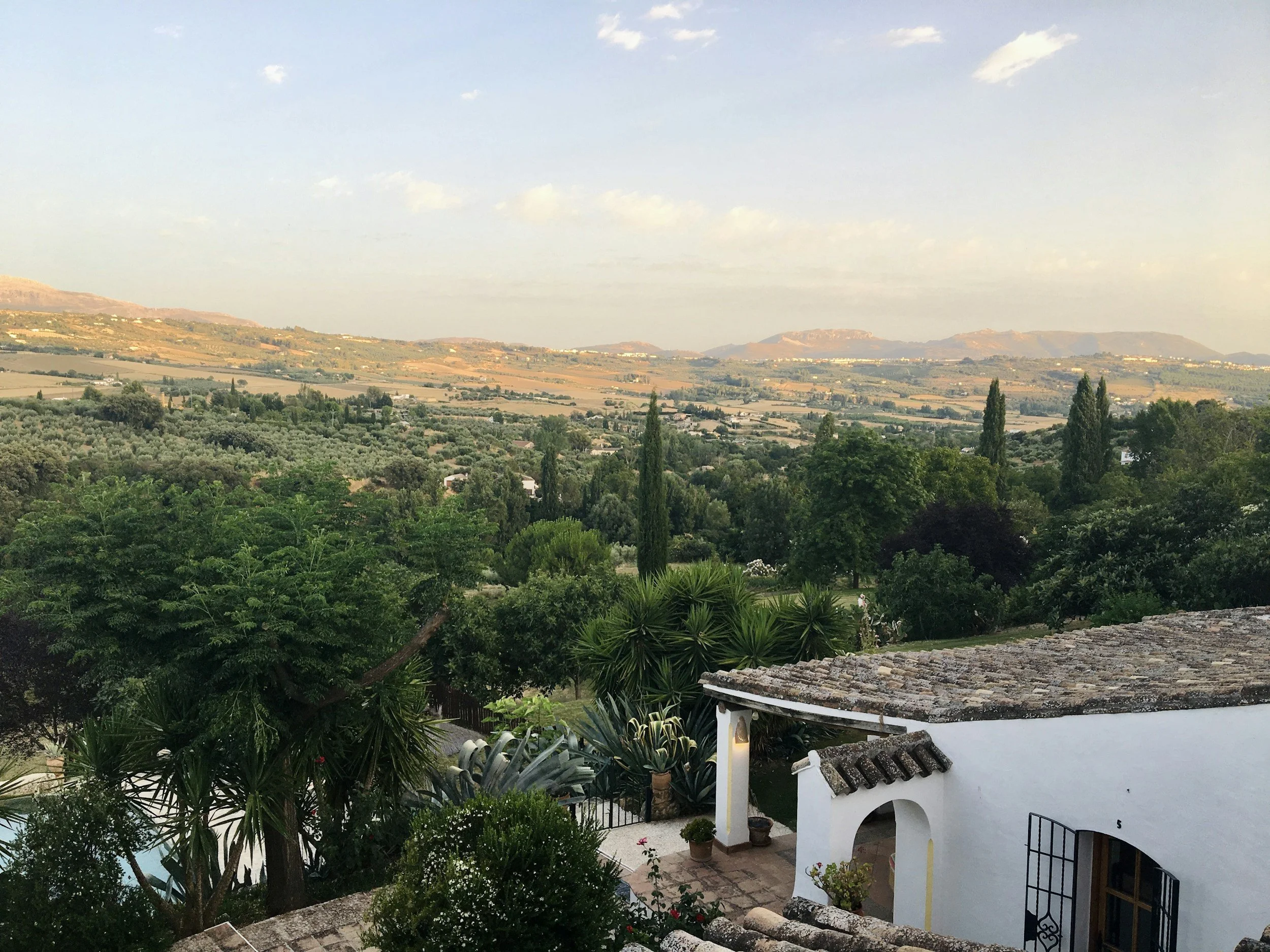
It's worth saying plainly: California's water ordinances stop at the California state line. The private family retreat we designed in Mallorcais not a MWELO project, and nothing about it should be read as regulatory guidance for a Mediterranean property - but the underlying discipline travels even where the regulation doesn't.
The estate's Mediterranean Healing Garden was composed specifically from succulents, desert flora and water-wise plants, described on the project itself as "a poetic composition... evoking the raw beauty of wilderness while offering balance to structured modern life." An olive and fruit grove roots the property in place rather than importing a foreign palette. None of it reads as a compromise. The pool, spa, fire-pit lounge and dining terraces sit inside a garden that was allocated water deliberately rather than abundantly, and the result is, if anything, more atmospheric for it - proof that water-wise design is a way of thinking about a site, not a regional code requirement that happens to produce a certain look.
A Community, Not Just a Property - HOA Landscape Design in San Diego
The same discipline, at the scale of a neighborhood.
Water-wise thinking doesn't stop at the property line. St. Malo Heights, an HOA community in San Diego, was working from a 1985 landscape plan: topiary requiring constant maintenance, invasive root systems damaging driveways and walkways, and an outdated irrigation system running up an annual maintenance, water and repair bill of $74,255 - a figure the HOA's own board flagged as a growing, compounding liability rather than a fixed cost.
The proposed redesign replaces high-water turf and invasive trees with California native planting, bioswales to capture rainfall, and drip irrigation across the community's shared spaces - organized zone by zone, from the main gathering island to the streetscape to the slope. The design projects a 50% reduction in water consumption and a 70% reduction in maintenance cost once the planting establishes, alongside a targeted 2–3°F reduction in local heat-island effect.
These are design projections, not measured results - and we say that deliberately. Proving a number like this empirically requires years of metered baseline data on a system this complex, which very few landscape practices ever track through to completion. But the underlying mechanisms are well established in the literature, not improvised. Added canopy and vegetation cool their surroundings primarily through shade and evapotranspiration: systematic reviews of urban green space find average cooling on the order of 2–4°C, with a measured, positive relationship between evapotranspiration rate and the reduction in heat-island intensity (npj Urban Sustainability, 2025; urban green space cooling review, PMC). That same shade lowers soil-surface evaporation and helps the ground hold moisture longer, while richer soil and mulch raise the reservoir the planting draws from. The direction of every one of these effects is settled science; the precise percentage for this specific community is what will only be provable once the planting matures and the monitoring years are in. This is the same water-wise logic applied at Rancho Santa Fe and Laguna Niguel, scaled to a shared community landscape where the return isn't just a more resilient garden - it's a smaller, more predictable line item on every resident's HOA bill.
The Research Behind the Method
The same question, asked for over a decade, in different places.
None of this is improvised per project. It traces back through a specific line of research. The starting point was a 2013 master's thesis at the University of Copenhagen, Designing Landscapes as Evolutionary Systems, tested against one of the most extreme post-industrial sites on earth — the Chernobyl Exclusion Zone - to argue that landscape form should emerge from process rather than being imposed as a fixed, final image.
That thinking became an operational framework in Southern California Wildlife & Biodiversity Landscape Restoration, which treats soil, flora and fauna as three inseparable layers, wildlife presence read as evidence of restored capacity, not decoration, and evaluated across multiple time horizons rather than judged at a single finished moment. Most recently, Landscape Ecosystem Integrity as Preventive Infrastructure makes the connection explicit: a landscape with high ecological integrity reduces disturbance, water waste, fire vulnerability, rising HOA maintenance bills - before it compounds into crisis, rather than reacting to it after the fact. St. Malo Heights' $74,255 annual liability is that same principle, expressed as a line item instead of an ecological metric.
FAQ
Does a water-wise estate have to look dry or sparse?
No. Canopy, layered planting, efficient irrigation and a considered soil strategy can lower water use while the garden still reads as full and alive - see Rancho Santa Fe, Mallorca and Laguna Niguel project above.
Will my mature trees survive a water-wise redesign?
Every tree is evaluated individually - species, health, roots, irrigation dependency and the proposed grading all factor in. Retention is a site-specific decision, not a blanket promise.
Does MWELO apply to my property?
Only for qualifying California projects - generally new landscapes of 5000+ sq ft where a permit or design review is required, per the current MWELO text. It does not apply outside California - Mallorca and other Mediterranean-climate projects are designed against local conditions instead.
Can you tell me exactly how much water my new landscape will use?
We can estimate proposed annual consumption in gallons, in total or by zone. We will only calculate a savings percentage against your existing landscape if a credible existing-use baseline is available - we don't publish invented figures.
Considering a water-wise landscape for your property?
Book a complimentary consultation to discuss your estate, your water use and a practical path toward a more resilient garden - wherever it sits, from San Diego County to Mallorca.
Editorial sources and supporting links
Projects referenced
Research referenced
Regulatory / technical sources
Peer-reviewed scientific sources
Tams, L. et al. (2023). Impact of shading on evapotranspiration and water stress of urban trees. Ecohydrology, Wiley.
(2025). Impact of soil moisture content on urban tree evaporative cooling and human thermal comfort. npj Urban Sustainability, Nature.
Cooling Benefits of Urban Tree Canopy: A Systematic Review (2024). Sustainability, MDPI.
Urban green space cooling effect in cities — PMC / NIH.
USDA NRCS — Effects on Soil Water Holding Capacity and Soil Water Retention.
Hydrological characteristics of different organic-material mulches (2023). Scientific Reports, Nature.